This afternoon I had two welcome items in my mailbox - my new passport (which means I can stop worrying about being able to head off to Ethiopia in June) and the latest The Christian Century. If you haven't had a chance to pick up an issue of this magazine, you're missing out. Good articles that make you think about theological issues are not a dime a dozen.
One of the articles in this particular issue of the mag that made me think is about intercessory prayer. In a recent edition of the New York Times, there was an article about another test on the effects of prayer on heart patients. And the news is apparently not all that good. According to this article, "prayers offered by strangers had no effect on the recovery of people who were undergoing heart surgery, a large and long-awaited study has found. And patients who knew they were being prayed for had a higher rate of postoperative complications."
The Christian Century offers a fantastic tongue-in-cheek memo to a congregation where Martin Copenhaver pleads with his church to stop praying for others (check it out if you can). It also offers this thought in another article about the same study: "the basic theological confusion here is to think that prayer puts God at our disposal, that prayers is a lever we use to nudge God in a specific direction. A God who is at our disposal in that way would not be God."
I've thought about prayer a lot over the years. Why do we pray, what "good" does prayer do. It always made me uncomfortable to think that my prayers are what could and would change God's mind about something. While that can be a powerful thought, it can also be unbearably burdening. If something bad happens to someone I love, it's because I didn't pray hard enough. And, as the writer of the previously mentioned article says, God who would so be at my disposal wouldn't be God. So, if my prayers, our prayers, are not about producing the results we want, if it's not a matter of praying just hard enough so that what we want comes to pass, then why do we pray? Should we pray?
We all have to decide that for ourselves. Me, I lean towards keeping up my prayers. Why? Because pray for me isn't so much about healing people or ridding the world of poverty or violence because I wish it hard enough - though certainly God knows I do pray hard for such things. Prayer is more about putting my trust in God and in what God does with me. When I pray for peace in the Middle East, I don't know if those prayers will sway God to intervene in new ways. But I do believe that those prayers sway me. My prayer changes me, gives me a passion and compassion that make me a stronger person, a better follower of Christ. Through prayer, I draw closer to God and in doing so, I believe I am empowered to be the change I wish to seek. This is not to say I don't believe prayers for other people can heal them in some way, but it is not why I pray. If study after study could show that intercessory prayers don't effect change on the person or places prayed for, I would still pray for others - in part because I know prayer changes and heals me.
To pray or not to pray - I choose to pray.
Friday, April 28, 2006

Monday, April 24, 2006
reflections from atlanta
What a week, what a week! It's amazing to me how you can be gone from a place for so long (for Atlanta and I, it was an 11 month seperation) and yet the moment you step foot on those familiar sidewalks, it feels like home. And then, even more amazing, was how much it felt like home when I drove up Beverley to my apartment. It's rather nice that I feel as though I have several homes, several places I feel completely comfortable.
While in Atlanta, along with seeing those dear friends and sights, I really enjoyed myself at the lectures, being intellectually stimulated is always nice. I enjoyed AmyPlantigua Pauw's dry wit (in referring to the Trinity, she had some particularly clever bits - the Holy Spirit is not the "His Girl Friday" to the Father or the Son, and we cannot just randomly pick things that go in threes to describe our triune God - no "rock, paper, scissors").
I also loved listening to George Stroup, the man who co-taught my theology courses with Shirley Guthrie. He is an excellent speaker and has that making you think thing down. He spoke about God's freedom from and for the world, something Shirley spoke of, and made me think about religion and political causes. He said that while Christ had a preferential option for the poor (something good liberation theologians are want to tell you) he did not defend or champion any program or institution. Speaking of Christ's "royal freedom" (Barth), he insisted that Christ did not align himself to any particular movement, any organization. Instead, "Jesus is the partisan of the poor who laid the axe at the root of all the trees." He challenged that the church's (difficult) task was to witness to Christ's partisanship of the poor without identifying it with a particular party or program.
I enjoyed this discussion because it's where I have been leaning and yet did not have the speech to claim what I have been thinking. I firmly believe in Christ's partisanship of the poor and yet am not comfortable with affiliating that with a particular political party or movement. It can be tempting to blend the two together - your faith and your politics - but I want to resist that urge. I want my faith to inform my politics but not the other way around. I don't want to claim that Jesus would vote for X - though I certainly want my relationship with Jesus to help me figure out who I should vote for. It was nice to finally be given theological reasoning for why I feel this way.
While in Atlanta, along with seeing those dear friends and sights, I really enjoyed myself at the lectures, being intellectually stimulated is always nice. I enjoyed AmyPlantigua Pauw's dry wit (in referring to the Trinity, she had some particularly clever bits - the Holy Spirit is not the "His Girl Friday" to the Father or the Son, and we cannot just randomly pick things that go in threes to describe our triune God - no "rock, paper, scissors").
I also loved listening to George Stroup, the man who co-taught my theology courses with Shirley Guthrie. He is an excellent speaker and has that making you think thing down. He spoke about God's freedom from and for the world, something Shirley spoke of, and made me think about religion and political causes. He said that while Christ had a preferential option for the poor (something good liberation theologians are want to tell you) he did not defend or champion any program or institution. Speaking of Christ's "royal freedom" (Barth), he insisted that Christ did not align himself to any particular movement, any organization. Instead, "Jesus is the partisan of the poor who laid the axe at the root of all the trees." He challenged that the church's (difficult) task was to witness to Christ's partisanship of the poor without identifying it with a particular party or program.
I enjoyed this discussion because it's where I have been leaning and yet did not have the speech to claim what I have been thinking. I firmly believe in Christ's partisanship of the poor and yet am not comfortable with affiliating that with a particular political party or movement. It can be tempting to blend the two together - your faith and your politics - but I want to resist that urge. I want my faith to inform my politics but not the other way around. I don't want to claim that Jesus would vote for X - though I certainly want my relationship with Jesus to help me figure out who I should vote for. It was nice to finally be given theological reasoning for why I feel this way.
Monday, April 10, 2006
After Easter
The Monday following Easter will find me on a plane headed toward Atlanta. For a week, I will be spending time at Columbia with friends and colleagues as we celebrate through worship and seminars the life of the late Shirley Guthrie. I’m looking forward to gathering with my peers, listening to lectures (without having to worry about taking notes!), and enjoying the culinary delights of my old hometown. I’m also looking forward to continuing my celebration of Easter.
I am excited that this gathering of my colleagues where in which will we celebrate the life of a beloved professor is following immediately after Easter. I fear that once Easter Day has come and gone, the celebration of the resurrection and the hope we have in it is no longer on the forefront of my mind. I get distracted, move on to the next Sunday, the next season in our church calendar. But this year, I will be spending my first “after Easter” days celebrating the life of Dr. Guthrie. When we celebrate the life of one who has died, we celebrate the promise we have for life everlasting, a promise we have because of what we celebrate this Easter Sunday. I am thankful that this year I will have an immediate reminder that the Good News of Easter is not just to be celebrated on Easter.
I am excited that this gathering of my colleagues where in which will we celebrate the life of a beloved professor is following immediately after Easter. I fear that once Easter Day has come and gone, the celebration of the resurrection and the hope we have in it is no longer on the forefront of my mind. I get distracted, move on to the next Sunday, the next season in our church calendar. But this year, I will be spending my first “after Easter” days celebrating the life of Dr. Guthrie. When we celebrate the life of one who has died, we celebrate the promise we have for life everlasting, a promise we have because of what we celebrate this Easter Sunday. I am thankful that this year I will have an immediate reminder that the Good News of Easter is not just to be celebrated on Easter.
Sunday, April 09, 2006
You Say You Want A Revolution
Texts: Psalm 118:1-2, 19-29
John 12:12-19
Expectations. We all have them – a lot of them if you think about it. We have our day to day expectations – the car is going to start in the morning when you head off to work, we’re going to make it through the school day without seriously embarrassing ourselves, the dinner we’re making is going to be appreciated by our family. Beyond the day to day, we all have more complicated expectations about how our life is going to be, how the people in our lives are going to act and react to what comes our way. We have serious expectations for ourselves, for our family, for our work, our friends, our God.
Our story this morning is about those serious expectations. We all know that Jesus’ entry is the beginning of the end, a brief moment of triumph before ultimate humiliation. We know this, but almost two thousand years ago when Jesus entered the city, the people who came out to meet him didn’t. No, they had an entirely different expectation for what was going to happen.
The great crowd that went out to meet Jesus was a mixed one. There were those that had been with him when he had raised Lazarus, those who had seen him perform a miracle beyond belief, those who had gone and testified to what they had seen. There were also those who had heard this testimony, heard that Christ had performed this amazing sign and were inspired to meet him. There were also probably those who didn’t really know what was going on – those who joined in the crowd because it was another thing to do amid the exciting chaos of the festival.
The one thing all those in this crowd had in common was that they were in Jerusalem as part of the celebration of the Passover. As you may have heard over the years on various Palm Sundays, this celebration is a wild time. It’s bound to be when you have as many as one hundred thousand people in a city that normal holds only eighty. There’s an energy that permeates the air. This energy is due in part because of the sheer numbers there to celebrate – but it is also due to what they are all there to celebrate. The Passover isn’t just any feast – it is a feast that celebrates perhaps the most important act of God in Jewish history. It is a feast that remembers when God delivered the people of Israel from Egyptian bondage under the leadership of a man named Moses. When times got rough, when another army invaded and another country occupied their land, this was the story the people told themselves over and over again. As our resident storytellers could tell you, stories powerfully affect people, can do more than entertain or education. They tell us who we are, who God is. They can inspire, heal. This story of deliverance is the one that gave hope to those who were not free.
The people who have gathered to celebrate this Passover are a people who know what it means to not be free. While Rome may not be the strictest or most vile of occupiers – they did bring things like sewer systems and running water after all – they were still occupiers. As long as Rome ruled, the people of Israel could not be what they had been and what they longed to be – a strong and independent nation. They longed for liberation, longed for another Moses to come and free them. These were the people who came out to meet Jesus. And so whether they had followed Jesus’ ministry for some time, whether they had just heard about what this man could do, or whether they weren’t even sure who it was they were greeting, they all had liberation on the mind.
They came rushing out to meet him as though he were a ruler, a king. They came out shouting, “Hosanna, hosanna” – a word that may be a greeting of praise, but one that also can be understood as a prayer meaning “save now” or “save us, please.” In their initial greeting, the crowd lets Jesus know, lets us know, what they expect from him – they expect this great man, the one who raised Lazarus from the dead, to save them too.
The salvation they are thinking of, they are expecting, is not the one that Jesus has come to bring. It becomes very clear that the crowd is thinking in earthly terms. They are not searching for some ethereal salvation, they are not thinking about how they are being occupied by sin, they are thinking about the real, physical forces that they see each day occupying their land.
Along with shouting their Hosannas, the crowd shouts a selection from Psalm 118, the psalm we read this morning and one they would have been reading as part of their festival celebrations. If you recall our psalm read: “Blessed is the one who comes in the name of the Lord. We bless you from the house of the Lord.” Yet the crowd shouted something a little different: “Blessed is the one who comes in the name of the Lord— the King of Israel!”
The crowd changes a familiar psalm about God’s role as creator and savior to include something new, The King of Israel. And there we have it. That is what the crowd is shouting for – the restoration of the Davidic line. That is who they see Jesus has – a revolutionary who has come to bring them their freedom. They shout “King of Israel” because that is what they want. It is not just through their words we know what they are expecting Jesus to free them from Roman rule.
We call today Palm Sunday because according to John’s Gospel the crowd ran out to greet Jesus with palms. Palms aren’t just pretty plants that someone thought would look good when waved. Palms were a symbol of revolution. About one hundred and fifty years earlier, a hero by the name of Simon Maccabaeus, delivered Jerusalem from a Hellenistic ruler who tried to ban the Jewish religion and defiled the temple. When Simon freed Jerusalem, the people celebrated by praise and palm branches. Since this time – which was the last period of independence the Jewish people knew – palms had become a symbol of Jewish desire for deliverance. This is the symbol the crowd is waving at Jesus.
There can’t be any doubt - this crowd is saying it wants a revolution. And they see Jesus as the one who can bring it to them. That is their expectation as they rush out to meet Christ on his entry into Jerusalem; as they follow him throughout the week, listening to him teach; as they watch stunned as their revolutionary leader is arrested, beaten, brought down low by the government he was suppose to free them from. No one understood – not even the disciples – when Christ told them throughout this week that it would be all right. All they could understand was that the man they had welcomed as a savior, as the King of Israel, was not coming through as they expected.
The crowd expected a revolution and when they didn’t get it, they turned on Jesus. They turned from shouts of Hosanna to shouts of hate. Even the disciples proved less than faithful when the one they followed was arrested and sentenced to death. Those who had followed Christ for some time, believed in him passionately, when their expectations were not met they felt angry, heartbroken, betrayed.
While we might be tempted to sit back and judge those who turned on Christ, we should resist such a temptation. For when our own expectations are not met, do we not feel the same? When people let us down, when we let ourselves down, are we not hurt, do we not feel anger? How much more would we feel the pain and betrayal of unmet expectations if the one to disappoint us was the same one who had shown us what wondrous signs he could perform? When the one who disappoints us is God?
The crowd that ran out to meet Christ expected something from him and they are not alone in that. Whether or not we are fully aware of them, each of us has expectations for our Christ, our God. Some of us may expect that God will not let serious harm befall us – that tragedy may visit others, but it will not us. Some of us may expect that God will always be clear in is expected of us – that the path God desires for us will be clearly marked. Some of us may expect that if we really would take the time to seek out God, we would easily feel God’s presence and quickly find peace. When the expectations that we have, consciously or unconsciously, are not met, when we are dealt a hand we never imagined God would allow, it is perfectly understandable that we would be angry, that we would be hurt, that we would want answers from God. In that pain and confusion, we might find ourselves like the crowd in Jerusalem so many years ago. We might turn on the one we had looked to for so much.
When we are disappointed by God, it will be a challenge to not let ourselves turn on God, to not abandon our God or our faith. We may struggle with finding a way to be anger, hurt, heartbroken and still be able to say, even in the quietest of voices, “Hosanna.”
This is quite a challenge. The crowd that met Christ with such joy and exuberance couldn’t do it. Even the disciples couldn’t all find watch as their expectations were dashed and still offer Christ “Hosanna.” But we have an advantage over the disciples and the others who followed Christ. Unlike this great crowd – and in fact, thanks to this crowd – we know that when expectations are not met, all is not lost, rather, something greater may be on the horizon. The people who rushed out to meet Christ expected deliverance from Rome and instead they got something so much better, something not even those closest to Christ could even conceive until it had come to pass. Instead of an earthy, temporary salvation, Christ offers eternal salvation.
The crowd didn’t understand, couldn’t see beyond their expectations, and so they did lash out, their Hosannas did turn to hate. But their story can inspire us to look beyond our own expectations. When we are disappointed in our journey of faith, this story can bring us hope that Christ again will offer us something greater than we could imagine or even fully comprehend. The people of Israel had the story of the Passover, recited it throughout the years, celebrated it with such hope for the future. This was the story that reminded them of what God would do. We have the story of Holy Week, a story of expectations celebrated, dashed and replaced by something so much better. This is the story that reminds us what God can do. This is the story that will not let us give up hope even when all seems lost. This is the story that can help us think beyond what we know and what we understand. This is the story we celebrate not just this week, but every week, day, minute of our lives. This is the story that keeps Hosannas in our hearts.
All praise, honor, and glory to the one who offers us such possibilities, who reaches beyond our expectations, who gives us more than we even know to want, who blesses us with such a story. Amen.
John 12:12-19
Expectations. We all have them – a lot of them if you think about it. We have our day to day expectations – the car is going to start in the morning when you head off to work, we’re going to make it through the school day without seriously embarrassing ourselves, the dinner we’re making is going to be appreciated by our family. Beyond the day to day, we all have more complicated expectations about how our life is going to be, how the people in our lives are going to act and react to what comes our way. We have serious expectations for ourselves, for our family, for our work, our friends, our God.
Our story this morning is about those serious expectations. We all know that Jesus’ entry is the beginning of the end, a brief moment of triumph before ultimate humiliation. We know this, but almost two thousand years ago when Jesus entered the city, the people who came out to meet him didn’t. No, they had an entirely different expectation for what was going to happen.
The great crowd that went out to meet Jesus was a mixed one. There were those that had been with him when he had raised Lazarus, those who had seen him perform a miracle beyond belief, those who had gone and testified to what they had seen. There were also those who had heard this testimony, heard that Christ had performed this amazing sign and were inspired to meet him. There were also probably those who didn’t really know what was going on – those who joined in the crowd because it was another thing to do amid the exciting chaos of the festival.
The one thing all those in this crowd had in common was that they were in Jerusalem as part of the celebration of the Passover. As you may have heard over the years on various Palm Sundays, this celebration is a wild time. It’s bound to be when you have as many as one hundred thousand people in a city that normal holds only eighty. There’s an energy that permeates the air. This energy is due in part because of the sheer numbers there to celebrate – but it is also due to what they are all there to celebrate. The Passover isn’t just any feast – it is a feast that celebrates perhaps the most important act of God in Jewish history. It is a feast that remembers when God delivered the people of Israel from Egyptian bondage under the leadership of a man named Moses. When times got rough, when another army invaded and another country occupied their land, this was the story the people told themselves over and over again. As our resident storytellers could tell you, stories powerfully affect people, can do more than entertain or education. They tell us who we are, who God is. They can inspire, heal. This story of deliverance is the one that gave hope to those who were not free.
The people who have gathered to celebrate this Passover are a people who know what it means to not be free. While Rome may not be the strictest or most vile of occupiers – they did bring things like sewer systems and running water after all – they were still occupiers. As long as Rome ruled, the people of Israel could not be what they had been and what they longed to be – a strong and independent nation. They longed for liberation, longed for another Moses to come and free them. These were the people who came out to meet Jesus. And so whether they had followed Jesus’ ministry for some time, whether they had just heard about what this man could do, or whether they weren’t even sure who it was they were greeting, they all had liberation on the mind.
They came rushing out to meet him as though he were a ruler, a king. They came out shouting, “Hosanna, hosanna” – a word that may be a greeting of praise, but one that also can be understood as a prayer meaning “save now” or “save us, please.” In their initial greeting, the crowd lets Jesus know, lets us know, what they expect from him – they expect this great man, the one who raised Lazarus from the dead, to save them too.
The salvation they are thinking of, they are expecting, is not the one that Jesus has come to bring. It becomes very clear that the crowd is thinking in earthly terms. They are not searching for some ethereal salvation, they are not thinking about how they are being occupied by sin, they are thinking about the real, physical forces that they see each day occupying their land.
Along with shouting their Hosannas, the crowd shouts a selection from Psalm 118, the psalm we read this morning and one they would have been reading as part of their festival celebrations. If you recall our psalm read: “Blessed is the one who comes in the name of the Lord. We bless you from the house of the Lord.” Yet the crowd shouted something a little different: “Blessed is the one who comes in the name of the Lord— the King of Israel!”
The crowd changes a familiar psalm about God’s role as creator and savior to include something new, The King of Israel. And there we have it. That is what the crowd is shouting for – the restoration of the Davidic line. That is who they see Jesus has – a revolutionary who has come to bring them their freedom. They shout “King of Israel” because that is what they want. It is not just through their words we know what they are expecting Jesus to free them from Roman rule.
We call today Palm Sunday because according to John’s Gospel the crowd ran out to greet Jesus with palms. Palms aren’t just pretty plants that someone thought would look good when waved. Palms were a symbol of revolution. About one hundred and fifty years earlier, a hero by the name of Simon Maccabaeus, delivered Jerusalem from a Hellenistic ruler who tried to ban the Jewish religion and defiled the temple. When Simon freed Jerusalem, the people celebrated by praise and palm branches. Since this time – which was the last period of independence the Jewish people knew – palms had become a symbol of Jewish desire for deliverance. This is the symbol the crowd is waving at Jesus.
There can’t be any doubt - this crowd is saying it wants a revolution. And they see Jesus as the one who can bring it to them. That is their expectation as they rush out to meet Christ on his entry into Jerusalem; as they follow him throughout the week, listening to him teach; as they watch stunned as their revolutionary leader is arrested, beaten, brought down low by the government he was suppose to free them from. No one understood – not even the disciples – when Christ told them throughout this week that it would be all right. All they could understand was that the man they had welcomed as a savior, as the King of Israel, was not coming through as they expected.
The crowd expected a revolution and when they didn’t get it, they turned on Jesus. They turned from shouts of Hosanna to shouts of hate. Even the disciples proved less than faithful when the one they followed was arrested and sentenced to death. Those who had followed Christ for some time, believed in him passionately, when their expectations were not met they felt angry, heartbroken, betrayed.
While we might be tempted to sit back and judge those who turned on Christ, we should resist such a temptation. For when our own expectations are not met, do we not feel the same? When people let us down, when we let ourselves down, are we not hurt, do we not feel anger? How much more would we feel the pain and betrayal of unmet expectations if the one to disappoint us was the same one who had shown us what wondrous signs he could perform? When the one who disappoints us is God?
The crowd that ran out to meet Christ expected something from him and they are not alone in that. Whether or not we are fully aware of them, each of us has expectations for our Christ, our God. Some of us may expect that God will not let serious harm befall us – that tragedy may visit others, but it will not us. Some of us may expect that God will always be clear in is expected of us – that the path God desires for us will be clearly marked. Some of us may expect that if we really would take the time to seek out God, we would easily feel God’s presence and quickly find peace. When the expectations that we have, consciously or unconsciously, are not met, when we are dealt a hand we never imagined God would allow, it is perfectly understandable that we would be angry, that we would be hurt, that we would want answers from God. In that pain and confusion, we might find ourselves like the crowd in Jerusalem so many years ago. We might turn on the one we had looked to for so much.
When we are disappointed by God, it will be a challenge to not let ourselves turn on God, to not abandon our God or our faith. We may struggle with finding a way to be anger, hurt, heartbroken and still be able to say, even in the quietest of voices, “Hosanna.”
This is quite a challenge. The crowd that met Christ with such joy and exuberance couldn’t do it. Even the disciples couldn’t all find watch as their expectations were dashed and still offer Christ “Hosanna.” But we have an advantage over the disciples and the others who followed Christ. Unlike this great crowd – and in fact, thanks to this crowd – we know that when expectations are not met, all is not lost, rather, something greater may be on the horizon. The people who rushed out to meet Christ expected deliverance from Rome and instead they got something so much better, something not even those closest to Christ could even conceive until it had come to pass. Instead of an earthy, temporary salvation, Christ offers eternal salvation.
The crowd didn’t understand, couldn’t see beyond their expectations, and so they did lash out, their Hosannas did turn to hate. But their story can inspire us to look beyond our own expectations. When we are disappointed in our journey of faith, this story can bring us hope that Christ again will offer us something greater than we could imagine or even fully comprehend. The people of Israel had the story of the Passover, recited it throughout the years, celebrated it with such hope for the future. This was the story that reminded them of what God would do. We have the story of Holy Week, a story of expectations celebrated, dashed and replaced by something so much better. This is the story that reminds us what God can do. This is the story that will not let us give up hope even when all seems lost. This is the story that can help us think beyond what we know and what we understand. This is the story we celebrate not just this week, but every week, day, minute of our lives. This is the story that keeps Hosannas in our hearts.
All praise, honor, and glory to the one who offers us such possibilities, who reaches beyond our expectations, who gives us more than we even know to want, who blesses us with such a story. Amen.
Wednesday, March 29, 2006
Games, Glorious Games!
 I love studying the Bible (most of you should know that by now!) but sometimes it's just nice to take a break and play. Tonight we took a break from our regularly scheduled Kerygma and had a game night instead. Thanks to Steve H and Nancy D, we also had wonderful balloon animals and lovely painted faces (which, sadly, I didn't get to).
I had a great time tonight playing Jenga, watching those braver than I try their hand at "Killer Bunnies," and listening to all the giggling (from kids and adults!). It reminded me of when my family would get together every Sunday night and just play. Sometimes we'd play cards, sometimes Monopoly, a few occasions we tried to make Mousetrap work. Those are some of my favorite memories, gathering as a family and playing. It was just so wonderful tonight, after supper, to gather around tables and play a variety of games, to join together as a family in Christ. We worship together, serve together, eat together - it was nice to play together. Let's do it again sometime soon!
Sunday, March 12, 2006
Road to Joy
Texts: Jeremiah 17:5-13
Mark 8:31-38
The idea that life can change quickly, shockingly, should be no surprise to any of us. During the last decade we have witnessed disasters, natural and human wrought, that have either ended life or forced those caught up in destruction’s path to face a life radically different from what they had known before. Katrina, the tsunami, September 11, Columbine. These events have become a litany that flow off the tongue more readily than any call to worship we might recite here. Though we are all one in Christ, there are certainly other life altering events your neighbor would have in her litany that you would not in yours. Only certain events affect us all on similar levels. I doubt many of you would include November 26th, 2005 in your litany. That day, the lives of four men, all our brothers in Christ, were radically changed.
Norman Kember, a 72 year old retired professor of medicine from London, James Loney, a 41 year old Canadian mediator, Harmeet Singh Sooden, a 32 year old Canadian engineer studying to be a teacher, and Tom Fox, a 54 year old father of two, musician, Virginian, were serving in Iraq as members of the Christian Peacemaking Team. Formed by Mennonites, Brethern, and Quakers over twenty years ago, this organization seeks to devote themselves fully to the cause of nonviolent peacemaking. These men entered the hottest zones in Iraq, unarmed, to help rebuild homes and lives destroyed by war, to speak out for those who had no voice. Working along side Muslim peacemaking groups, the four men earned the respect of many who found it hard to trust those from the West.
On November 26, 2005, these men who went to Iraq to serve the Iraqi people, were taken hostage by a group calling themselves the Swords of Righteousness Brigade. This group threatened to kill the four Christian peacemakers unless all prisoners in US and Iraqi-run detention facilities were released. Deadlines have come and gone and until recently, no one has been sure of what has happened or was going to happen.
For the family of Tom Fox, March 9, 2006 will undoubtedly be added to their list of life changing days. This Thursday, Tom’s body was found after he had been conspicuously absent from a video showing the other three peacemakers that aired Tuesday. We don’t know when he was killed, we don’t know – though I’m sure we could all speculate – why Tom was killed and not the other 3. It’s frustrating – this not knowing – because there is a lot we don’t know and may never know. But we do know one thing – we know why Tom and his fellow peacemakers were in Iraq in the first place.
The world of Iraq is not safe – anyone who has loved ones who have been or are still over there know this too well. Why do people go to such a dangerous place? Some people go over because they have been required to by their government; some go over because the opportunities for financial improvement are so much greater than can be found here; some go because they believe good work can and must be done and they want to be a part of it. The four members of the Christian Peacemaking Team were among those who went to Iraqi because of their belief there was good to be done. But it wasn’t just “good work,” it was God’s work.
The day before the four men were taken, Tom, a Quaker who went to Iraq believing that there is that of God in every person, wrote an article that spoke to the very question – why are we here? This is how he answers: “If I understand the message of God, his response to that question is that we are to take part in the creation of the Peaceable Realm of God. Again, if I understand the message of God, how we take part in the creation of this realm is to love God with all our heart, our mind and our strength and to love our neighbors and enemies as we love God and ourselves.”
Tom Fox and his fellow Christian Peacemakers found themselves in harms way, found themselves more vulnerable to life altering events like the one they experienced on November 26th, because they believed the message of God is to take part in the creation of God’s kingdom here on earth. These men left safety behind, left their self-orientated interest behind, in order to come take part in God’s work in Iraq.
Tom, Norman, James, and Harmeet are not alone in this journey – others, in Iraq here and now and in other places in other times, have left behind security and the interests of the self for the sake of the gospel.
One of the very first to take up his cross and follow Christ is the same one who rebukes Christ. Just after Peter confesses Jesus as the Christ, as the Messiah for the first time, and just before he witnesses the transfiguration and hears God proclaim Christ the beloved, he has – a moment. Jesus predicts what lays in store for him – rejection, death, resurrection – for the first time. Peter, hearing that the man he has just acknowledged as Messiah speaking of his rejection by the powerful and his subsequent death, does not react well. He takes his Teacher aside and rebukes him as one might a child. The writer of Mark does not tell us what Peter may have said but the writer of Matthew does. In Matthew’s account of this story, Peter tells Jesus that these things cannot happen to him. Peter cannot believe that the Anointed One – the one who is supposed to be all powerful - will be rejected and killed – the resurrection part of Christ’s prediction doesn’t seem to register.
Jesus, who is normally quite calm when one of his disciples questions him, even speaks down to him, reacts quite strongly. He refers to Peter by the name of the Tempter, the Prince of Lies. We don’t know what about Peter’s words illicit such harsh rebuke – is it that Jesus would be tempted to become Peter’s Messiah – a Messiah who conquers, not suffers – and therefore is lashing out at his temptation and tempter? Is it that Peter, who just announced Jesus as the Messiah is, with his rebuke, lying to himself and his fellow disciples about what being a follower of this Messiah has in store? Is it perhaps a little bit of both? Peter’s mind is set on human things, not divine, and Jesus is setting him – and perhaps himself – straight.
Jesus, after dealing with Peter harshly, moves to his more traditional response to a disciple’s misunderstanding and questioning – he uses to the incident to teach, to offer further insight into the Son of Man and what it means to be his follower. To be Christ’s follower, one must deny oneself, take up the cross and follow him.
Jesus’ words here have been a cornerstone in our understanding of what it means to be a disciple. Unfortunately, that understanding has often been as misguided as Peter’s. This passage has been used to justify not self-denial, but self-abuse. People over the centuries have taken up their crosses with such fervor that suffering isn’t something that they endure, it’s something they seek out. They more they suffer, the more they are closer to Christ – at least that’s what some thought. Self-flagellation, hair shirts, refusing to eat anything you might enjoy – disciplines like these were practiced by men and women of faith for years – in some communities they still are. They are practiced because some have understood denying yourself to mean deny any joy, any pleasure, any happiness you might experience in this world. Whatever burdens may come your way, take them on. Do not seek to better your life, do not seek to live out what you want if others want you to do or be something else.
This understanding, it’s all wrong. Plain and simple. Following Christ is not about causing yourself pain or giving to others to the point that you have no sense of self left. It is what Peter did not do – setting your mind on divine and not human things. To deny yourself, take the cross, and follow Christ, is to no longer be guided by self interests but by Godly interests. It is putting your trust not in mere flesh, even your own flesh, but in the Lord. Those who deny themselves and take up the cross are those who participate in God’s work on earth. Those who risk suffering, rejection, and yes, even death, for the sake of the gospel. Those who live out, no matter where it might take them, the message of loving God with all our heart, our mind and our strength and to love our neighbors and enemies as we love God and ourselves.
It took him awhile, but Peter finally understood what it meant to be a follower of Christ. Though before the resurrection he questioned Christ, rebuked Christ, and even denied Christ, after Peter witnessed the truth of Jesus’ passion prediction, after he came to understand that in Christ human death is not the end, he truly became a follower of the one who had called to him so long ago. Tradition tells us that Peter, the one who balked at the thought of Jesus dying, the one who denied him at his death, was killed living and preaching the gospel.
Peter followed Christ. Tom Fox followed Christ. You and I are here because we want to follow Christ.
Does this mean that we as followers may, like Peter and Tom, give our very lives for the sake of the gospel? Maybe. That answer frightens but we cannot escape it. Christ says that those who lose their life for his sake will save it. Followers of Christ throughout the centuries have given their lives for his sake. Though we have a comfortable existence, we might find our faith leading us to places or situations in which we risk our safety, our lives. We might.
Discipleship is not an easy undertaking. But the cross we are called to take up does not necessarily equal physical death. Dietrich Bonhoeffer, a man whose life was ended because of the path he followed out of his faith, believed the cross was not the terrible end to an otherwise god-fearing and happy life – it, instead, meets believers at the beginning of their communion with Christ. “When Christ calls a person,” he says “he bids come and die.”
All of us can add another day to our litany of life altering moments – the day or moment we first responded to God’s grace already at work within us, the moment we consciously decided or when we realized we had unconsciously decided some time ago to follow Christ. Because on that day, we did die. We died as a person oriented in self and rose to new life as person who puts full trust in God. Our old life of doing what we wanted when we wanted, or for some of us, doing what others wanted of us when they wanted, is gone. Our new life, of doing God’s will when God wills it, is here. In our new life we trust that even if we follow God into a place where we lose our physical life, we have not lost our life in Christ. And that is truly the cornerstone of our faith, of being a disciple. It is trusting in God, God’s work in and through you, that even the threat of death does not keep you from following.
Do not let the fates of believers such as Dietrich Bonhoeffer, Tom Fox, or Peter deter you from following the Lord. Let them inspire you. These men, like other women and men throughout history, had such strength and courage of belief that they did not see death as final. Their journey with Jesus was not a journey filled with abuse, the cross was not a burden. The road they were on did not lead them to despair – it led them to joy. It led them to the joy we all may share in the resurrection of the Lord. Amen.
Mark 8:31-38
The idea that life can change quickly, shockingly, should be no surprise to any of us. During the last decade we have witnessed disasters, natural and human wrought, that have either ended life or forced those caught up in destruction’s path to face a life radically different from what they had known before. Katrina, the tsunami, September 11, Columbine. These events have become a litany that flow off the tongue more readily than any call to worship we might recite here. Though we are all one in Christ, there are certainly other life altering events your neighbor would have in her litany that you would not in yours. Only certain events affect us all on similar levels. I doubt many of you would include November 26th, 2005 in your litany. That day, the lives of four men, all our brothers in Christ, were radically changed.
Norman Kember, a 72 year old retired professor of medicine from London, James Loney, a 41 year old Canadian mediator, Harmeet Singh Sooden, a 32 year old Canadian engineer studying to be a teacher, and Tom Fox, a 54 year old father of two, musician, Virginian, were serving in Iraq as members of the Christian Peacemaking Team. Formed by Mennonites, Brethern, and Quakers over twenty years ago, this organization seeks to devote themselves fully to the cause of nonviolent peacemaking. These men entered the hottest zones in Iraq, unarmed, to help rebuild homes and lives destroyed by war, to speak out for those who had no voice. Working along side Muslim peacemaking groups, the four men earned the respect of many who found it hard to trust those from the West.
On November 26, 2005, these men who went to Iraq to serve the Iraqi people, were taken hostage by a group calling themselves the Swords of Righteousness Brigade. This group threatened to kill the four Christian peacemakers unless all prisoners in US and Iraqi-run detention facilities were released. Deadlines have come and gone and until recently, no one has been sure of what has happened or was going to happen.
For the family of Tom Fox, March 9, 2006 will undoubtedly be added to their list of life changing days. This Thursday, Tom’s body was found after he had been conspicuously absent from a video showing the other three peacemakers that aired Tuesday. We don’t know when he was killed, we don’t know – though I’m sure we could all speculate – why Tom was killed and not the other 3. It’s frustrating – this not knowing – because there is a lot we don’t know and may never know. But we do know one thing – we know why Tom and his fellow peacemakers were in Iraq in the first place.
The world of Iraq is not safe – anyone who has loved ones who have been or are still over there know this too well. Why do people go to such a dangerous place? Some people go over because they have been required to by their government; some go over because the opportunities for financial improvement are so much greater than can be found here; some go because they believe good work can and must be done and they want to be a part of it. The four members of the Christian Peacemaking Team were among those who went to Iraqi because of their belief there was good to be done. But it wasn’t just “good work,” it was God’s work.
The day before the four men were taken, Tom, a Quaker who went to Iraq believing that there is that of God in every person, wrote an article that spoke to the very question – why are we here? This is how he answers: “If I understand the message of God, his response to that question is that we are to take part in the creation of the Peaceable Realm of God. Again, if I understand the message of God, how we take part in the creation of this realm is to love God with all our heart, our mind and our strength and to love our neighbors and enemies as we love God and ourselves.”
Tom Fox and his fellow Christian Peacemakers found themselves in harms way, found themselves more vulnerable to life altering events like the one they experienced on November 26th, because they believed the message of God is to take part in the creation of God’s kingdom here on earth. These men left safety behind, left their self-orientated interest behind, in order to come take part in God’s work in Iraq.
Tom, Norman, James, and Harmeet are not alone in this journey – others, in Iraq here and now and in other places in other times, have left behind security and the interests of the self for the sake of the gospel.
One of the very first to take up his cross and follow Christ is the same one who rebukes Christ. Just after Peter confesses Jesus as the Christ, as the Messiah for the first time, and just before he witnesses the transfiguration and hears God proclaim Christ the beloved, he has – a moment. Jesus predicts what lays in store for him – rejection, death, resurrection – for the first time. Peter, hearing that the man he has just acknowledged as Messiah speaking of his rejection by the powerful and his subsequent death, does not react well. He takes his Teacher aside and rebukes him as one might a child. The writer of Mark does not tell us what Peter may have said but the writer of Matthew does. In Matthew’s account of this story, Peter tells Jesus that these things cannot happen to him. Peter cannot believe that the Anointed One – the one who is supposed to be all powerful - will be rejected and killed – the resurrection part of Christ’s prediction doesn’t seem to register.
Jesus, who is normally quite calm when one of his disciples questions him, even speaks down to him, reacts quite strongly. He refers to Peter by the name of the Tempter, the Prince of Lies. We don’t know what about Peter’s words illicit such harsh rebuke – is it that Jesus would be tempted to become Peter’s Messiah – a Messiah who conquers, not suffers – and therefore is lashing out at his temptation and tempter? Is it that Peter, who just announced Jesus as the Messiah is, with his rebuke, lying to himself and his fellow disciples about what being a follower of this Messiah has in store? Is it perhaps a little bit of both? Peter’s mind is set on human things, not divine, and Jesus is setting him – and perhaps himself – straight.
Jesus, after dealing with Peter harshly, moves to his more traditional response to a disciple’s misunderstanding and questioning – he uses to the incident to teach, to offer further insight into the Son of Man and what it means to be his follower. To be Christ’s follower, one must deny oneself, take up the cross and follow him.
Jesus’ words here have been a cornerstone in our understanding of what it means to be a disciple. Unfortunately, that understanding has often been as misguided as Peter’s. This passage has been used to justify not self-denial, but self-abuse. People over the centuries have taken up their crosses with such fervor that suffering isn’t something that they endure, it’s something they seek out. They more they suffer, the more they are closer to Christ – at least that’s what some thought. Self-flagellation, hair shirts, refusing to eat anything you might enjoy – disciplines like these were practiced by men and women of faith for years – in some communities they still are. They are practiced because some have understood denying yourself to mean deny any joy, any pleasure, any happiness you might experience in this world. Whatever burdens may come your way, take them on. Do not seek to better your life, do not seek to live out what you want if others want you to do or be something else.
This understanding, it’s all wrong. Plain and simple. Following Christ is not about causing yourself pain or giving to others to the point that you have no sense of self left. It is what Peter did not do – setting your mind on divine and not human things. To deny yourself, take the cross, and follow Christ, is to no longer be guided by self interests but by Godly interests. It is putting your trust not in mere flesh, even your own flesh, but in the Lord. Those who deny themselves and take up the cross are those who participate in God’s work on earth. Those who risk suffering, rejection, and yes, even death, for the sake of the gospel. Those who live out, no matter where it might take them, the message of loving God with all our heart, our mind and our strength and to love our neighbors and enemies as we love God and ourselves.
It took him awhile, but Peter finally understood what it meant to be a follower of Christ. Though before the resurrection he questioned Christ, rebuked Christ, and even denied Christ, after Peter witnessed the truth of Jesus’ passion prediction, after he came to understand that in Christ human death is not the end, he truly became a follower of the one who had called to him so long ago. Tradition tells us that Peter, the one who balked at the thought of Jesus dying, the one who denied him at his death, was killed living and preaching the gospel.
Peter followed Christ. Tom Fox followed Christ. You and I are here because we want to follow Christ.
Does this mean that we as followers may, like Peter and Tom, give our very lives for the sake of the gospel? Maybe. That answer frightens but we cannot escape it. Christ says that those who lose their life for his sake will save it. Followers of Christ throughout the centuries have given their lives for his sake. Though we have a comfortable existence, we might find our faith leading us to places or situations in which we risk our safety, our lives. We might.
Discipleship is not an easy undertaking. But the cross we are called to take up does not necessarily equal physical death. Dietrich Bonhoeffer, a man whose life was ended because of the path he followed out of his faith, believed the cross was not the terrible end to an otherwise god-fearing and happy life – it, instead, meets believers at the beginning of their communion with Christ. “When Christ calls a person,” he says “he bids come and die.”
All of us can add another day to our litany of life altering moments – the day or moment we first responded to God’s grace already at work within us, the moment we consciously decided or when we realized we had unconsciously decided some time ago to follow Christ. Because on that day, we did die. We died as a person oriented in self and rose to new life as person who puts full trust in God. Our old life of doing what we wanted when we wanted, or for some of us, doing what others wanted of us when they wanted, is gone. Our new life, of doing God’s will when God wills it, is here. In our new life we trust that even if we follow God into a place where we lose our physical life, we have not lost our life in Christ. And that is truly the cornerstone of our faith, of being a disciple. It is trusting in God, God’s work in and through you, that even the threat of death does not keep you from following.
Do not let the fates of believers such as Dietrich Bonhoeffer, Tom Fox, or Peter deter you from following the Lord. Let them inspire you. These men, like other women and men throughout history, had such strength and courage of belief that they did not see death as final. Their journey with Jesus was not a journey filled with abuse, the cross was not a burden. The road they were on did not lead them to despair – it led them to joy. It led them to the joy we all may share in the resurrection of the Lord. Amen.
Monday, March 06, 2006
for the love of Lent
Everyone seems to have a favorite season. Some love Fall – the colors, the back-to-back holidays. Some love Spring – the flowers, the warming air. My favorite season? Lent. That old saying – it’s not the destination but the journey that matters – that’s how I appreciate Lent.
We enter into Lent dusting ourselves with ashes, acknowledging in worship and in ritual that we are mortal. Because of our mortality, we cannot hope to overcome death. Because of our depravity, we cannot hope to overcome sin. And so as we begin Lent, we turn to the one who can and has overcome both sin and death. We turn to Christ and we follow him – as best we can – on his journey to the cross.
We follow with sacrifices of our own – giving up that favorite dessert or perhaps that habit of ours which we have long wanted to let go. We follow by taking up new practices – daily prayer journaling or working at the soup kitchen once a week. We follow, keeping Christ’s sacrifice on the forefront of our minds by what we have given or taken up, trying to participate in Christ’s journey as best we can.
We go through this journey, year after year, because it is only by walking this path that we might truly appreciate Easter. If we are to celebrate Christ’s resurrection and the hope of eternal life we have through him, we must first observe Christ’s journey to the cross. In this long and oft challenging season of Lent, we have sacred space in which we might come to appreciate what Christ gave to us, what Christ sacrificed for us.
I love Easter but I know I could not shout with true joy “Christ is risen!” had I not spent the six weeks of Lent looking toward the cross.
Sunday, February 26, 2006
When She Believes
Text: John 4:1-29,v39-42
It’s a shame we don’t have more wells around town. Wells are interesting places – the perfect locale to meet your friends who are drawing water too and share the day’s gossip. And heads up all you single ladies, a well is a great site to meet new and interesting visitors who may later turn into something more. A woman named Zipporah met her future husband, a nice Egyptian fellow named Moses, for the first time at a well. And if we’re talking about wells, we can’t forget that sweet Rachel meets her future husband (and future brother-in-law) Jacob at the wellside.
A well is a great place to make such connections because it is teaming with life. At least during the morning and the evening. The well at noon, however, when the sun is at its highest and hottest, is clear of any of the gossiping crowds. The well in our story this morning is free of any gossiping gaggles – but it is not an empty scene. As we sit beside the well with Jesus, a woman approaches both the well and the man sitting by it – a woman who has chosen to fill her jugs of water during the worst time of the day.
Even before we hear her speak, we know there is something different about this woman. A woman who comes to the well at noon, when she is almost assured of meeting no one else, very likely has a reason for taking such pains to avoid making connections with those she might find at the well.
Just as the woman’s presence at the well is a little surprising, so too is Jesus’ – though it has nothing to do with the time of day. That Jesus would be in Samaria at all would have been more than enough to raise the eyebrows of those pious Pharisees he left behind. As John mentioned a few weeks ago when speaking about the Good Samaritan – Jews and Samaritans did not mix. Though descendants of Abraham, the Samaritans intermarried with the foreigners and began worshiping God (and sometimes other gods) on a mountain temple other than Solomon’s temple in Jerusalem. These offenses were enough for the Jews to despise the Samaritans as heretics.
Into a land filled with these heretics comes Jesus. Our text tells us that on his way from Judea to Galilee, to continue his ministry among the Jews, he has to pass through Samaria. Jesus’ “had to pass through” wasn’t about getting from point A to point B – like we may have heard before. Geographically, he had other options for going from Judea to Galilee, options that didn’t include Samaria. Jesus “had to” pass through because of whom he would meet, what he would do, while in Samaria. He had to pass through because of the people he would encounter and the lives he would change. The first person he meets is this woman who has come to draw water.
“Give me a drink of water” – are his first words to her. Though Jesus’ request for water is a perfectly reasonable one – such basic hospitality was an acceptable expectation – the woman immediately questions him, given their hostile heritage – “How is it that you, a Jew, ask a drink of me, a woman of Samaria?” Jesus, oh Jesus loves a good question like this. Give him a slight crack of the door, and he’ll burst it wide open. And he has a way of not actually answering the question asked. Here Jesus doesn’t speak of some sort of ethnic equality, rather, he speaks of living water – something which this poor woman takes rather literally, not unlike the Pharisee Nicodemus whom Jesus encountered in Judea just before he met her. Also not unlike his encounter with Nicodemus, Jesus does not let this woman’s concrete thinking stop him from talking about this living water that will quench every thirst and gushes up into eternal life.
Now while the woman may not fully understand what Jesus is speaking of, she is still thinking in earthly terms, she is not a fool – she knows she wants this living water. In the face of her request, Jesus doesn’t reach down deep into the well and offer her baptism (as we might have expected given that his ministry in Judea had revolved around that act). Instead, he reaches deep into her, revealing to us why she wanted to avoid the people of her village, revealing to her that he is more than a man that can speak poetically about water.
This woman – as it turns out – may have found more than enough success at meeting men at wells for she has had five husbands. Five. Now, we don’t know how much Samaritan laws differed from Jewish laws, but we do know that at this time, 3 husbands in your lifetime was the limit for a Jewish woman. To a Jewish man, as Jesus was, this woman was two husbands past decency. To top it off, the man she is with now is not even her husband. No wonder this woman avoided those gossiping groups – they were very likely gossiping about her.
The man she meets at the well this day, does not gossip about her. He tells her what he knows of her, not in derision, not in contempt, but in care – Jesus is showing her how much he knows her and as he continues to speak to her, he helps to develop a bond between them by letting her know him. When asked, he tells her he is this Messiah she has heard about. We read in our text that Jesus responds – I am he – but the Greek reads only “I am.” As an awed Moses once heard those words from a burning bush, this Samaritan woman hears Jesus claim not only his position as Messiah, but as the one who is known only as “I am” – YHWH.
Though it is different than Zipporah and Moses’, or Rachel and Jacob’s, the Samaritan woman and Jesus share a deep and meaningful connection. They know things about one another that two strangers meeting by a wellside never would. It is this connection that stirs this woman to action. Though she still may not be clear about living water or about salvation, she believes in this connection. And her belief prompts her to no longer avoid her fellow Samaritans, rather to actively seek them out. When she meets with her fellow Samaritans, she does not timidly offer witness to what she has experienced – she boldly speaks up, commanding the people to “Come and see a man who told me everything I have ever done!”
She does not say “come and see a man who speaks of living water… or a man who tells of worshiping in truth and spirit,” rather “come and see a man who knows me.” And though she still wonders if he could really be the Messiah, she believes in what she has experienced with him and she speaks to all those around her of that experience.
In this story where Christ engages a shamed woman in serious conversation, there are many things we might learn from our Savior. We might glean information about eternal life, about how to worship, about not condemning those who have fallen from our moral standards. We could learn much from Jesus, but on this day as we celebrate the gifts of women, it is the Samaritan woman and her bold, brave speech that perhaps should inform and inspire.
As you may have noticed by looking through your bulletin, this year, 2006, is a big year in terms women and the life of the church. It’s the 100th anniversary of women being ordained as deacons and it’s the 50th anniversary of women being ordained as Ministers of Word and Sacrament. As wonderful as those celebrations are, there’s another anniversary that bears notice.
In 1916, 90 years ago, Katherine Bennet, the president of the Women’s Home Board, made a report to the General Assembly, the national governing body of the Presbyterian Church. This report marked the first time a woman was allowed to speak at a General Assembly. This report was the first indication that the previous attitude toward women speaking was going to change. Women not being permitted to speak in church had been the standard. In fact, just 25 years prior to Bennet speaking before this body of the church, the General Assembly had this to say – “It is the settled doctrine of our church that women are excluded from licensure and ordination by the plain teaching of the Scriptures and, therefore, cannot be admitted to our pulpits as authorized preachers of the Word; and, also, that they are prohibited from speaking by way of exhortation, or leading in prayer, or discussing any question publicly in the meetings of the church or congregation as a mixed assembly.”
Women who a particular connection to Christ and wanted to share what they knew of him, had to work hard for the right to speak, to overcome such views. And they did work. Sometimes they went further than the church allowed – several women were ordained by sympathetic presbyteries only to find that ordination later revoked. Sometimes they waited for the church to approve before they spoke in public assemblies, yet worked hard to get that approval.
Women like Margaret Towner who was the first woman ordained in our Presbyterian church, or Louisa Wooley who was the first woman ordained by the Cumberland Presbyterian Church (a sister to our own denomination), these women struggled to be heard and yet they did not give up and they did not keep quiet.
These women followed in the footsteps of our Samaritan woman. Today as we celebrate gifts of women in the church – it is this gift, this particular gift of speech, we all can celebrate. Each of us, male or female, has been given the gift of examples like Margaret and Louisa, of the Samaritan woman who spoke out so long ago. And in these examples, we have exciting hope and a certain challenge for our own life in Christ.
As believers in the faith, we are each called to be a witness, to proclaim what we have seen and known of Christ. Each of us, whether or not we have been called to ordained ministry, has been called to speak. Our speech doesn’t have to be grand statements before governing bodies, or sermons before congregations. We speak when we feel that tug on our hearts to share our experience of Christ. When Jesus commanded his disciples to be his witnesses, he did not only mean those who stood before him in that time and place. We have been called to be witnesses to Christ in deed and in word.
Like the women who were the first to speak in our church, we may comes across that which may try to keep us from speaking. People may dissuade us from speech because of who we are – because our gender, our age, education, class, any myriad of classifications others might feel should prevent us from speaking. Our own insecurities may push us to keep quiet – I’m not good enough, not smart enough, not eloquent enough. We may doubt that others would want to hear what we might say, doubt that they would listen when we spoke of our faith, our experience, doubt that the Spirit could speak through us.
But no matter what others may say, not matter what insecurities we may feel, not matter what doubts may plague us, we must believe. Believe in our own connection with Christ, even those connections that leave room for confusion. Believe that even if some may not show it, all are longing to know and be known by Christ. Believe that Christ may indeed speak through us.
We must believe like the Samaritan woman believed because when we do, God’s power and glory can shine so brightly. The Samaritan woman believed in the moment she had with Christ, believed in the feelings it stirred up in her, and look what happened when she believed. She did not let her fear of judgment stop her from seeking those she once avoided, she spoke what she knew, even though she still had questions, and through her testimony, the Spirit sparked a desire to search in those she met. After hearing her, other Samaritans sought Christ and came to believe for themselves.
The Samaritan woman believed, women like Margaret and Louisa believed, and now you and I are called to believe. Believe and speak of the one who inspires such belief. Though you may not stir a whole people to search out Jesus with your speech, though you may not find yourself as the first to break down barriers, your speech, your witness to the Christ whom you know and who knows you is precious. It is a gift, one that, be you man or woman, we celebrate this day. Amen.
It’s a shame we don’t have more wells around town. Wells are interesting places – the perfect locale to meet your friends who are drawing water too and share the day’s gossip. And heads up all you single ladies, a well is a great site to meet new and interesting visitors who may later turn into something more. A woman named Zipporah met her future husband, a nice Egyptian fellow named Moses, for the first time at a well. And if we’re talking about wells, we can’t forget that sweet Rachel meets her future husband (and future brother-in-law) Jacob at the wellside.
A well is a great place to make such connections because it is teaming with life. At least during the morning and the evening. The well at noon, however, when the sun is at its highest and hottest, is clear of any of the gossiping crowds. The well in our story this morning is free of any gossiping gaggles – but it is not an empty scene. As we sit beside the well with Jesus, a woman approaches both the well and the man sitting by it – a woman who has chosen to fill her jugs of water during the worst time of the day.
Even before we hear her speak, we know there is something different about this woman. A woman who comes to the well at noon, when she is almost assured of meeting no one else, very likely has a reason for taking such pains to avoid making connections with those she might find at the well.
Just as the woman’s presence at the well is a little surprising, so too is Jesus’ – though it has nothing to do with the time of day. That Jesus would be in Samaria at all would have been more than enough to raise the eyebrows of those pious Pharisees he left behind. As John mentioned a few weeks ago when speaking about the Good Samaritan – Jews and Samaritans did not mix. Though descendants of Abraham, the Samaritans intermarried with the foreigners and began worshiping God (and sometimes other gods) on a mountain temple other than Solomon’s temple in Jerusalem. These offenses were enough for the Jews to despise the Samaritans as heretics.
Into a land filled with these heretics comes Jesus. Our text tells us that on his way from Judea to Galilee, to continue his ministry among the Jews, he has to pass through Samaria. Jesus’ “had to pass through” wasn’t about getting from point A to point B – like we may have heard before. Geographically, he had other options for going from Judea to Galilee, options that didn’t include Samaria. Jesus “had to” pass through because of whom he would meet, what he would do, while in Samaria. He had to pass through because of the people he would encounter and the lives he would change. The first person he meets is this woman who has come to draw water.
“Give me a drink of water” – are his first words to her. Though Jesus’ request for water is a perfectly reasonable one – such basic hospitality was an acceptable expectation – the woman immediately questions him, given their hostile heritage – “How is it that you, a Jew, ask a drink of me, a woman of Samaria?” Jesus, oh Jesus loves a good question like this. Give him a slight crack of the door, and he’ll burst it wide open. And he has a way of not actually answering the question asked. Here Jesus doesn’t speak of some sort of ethnic equality, rather, he speaks of living water – something which this poor woman takes rather literally, not unlike the Pharisee Nicodemus whom Jesus encountered in Judea just before he met her. Also not unlike his encounter with Nicodemus, Jesus does not let this woman’s concrete thinking stop him from talking about this living water that will quench every thirst and gushes up into eternal life.
Now while the woman may not fully understand what Jesus is speaking of, she is still thinking in earthly terms, she is not a fool – she knows she wants this living water. In the face of her request, Jesus doesn’t reach down deep into the well and offer her baptism (as we might have expected given that his ministry in Judea had revolved around that act). Instead, he reaches deep into her, revealing to us why she wanted to avoid the people of her village, revealing to her that he is more than a man that can speak poetically about water.
This woman – as it turns out – may have found more than enough success at meeting men at wells for she has had five husbands. Five. Now, we don’t know how much Samaritan laws differed from Jewish laws, but we do know that at this time, 3 husbands in your lifetime was the limit for a Jewish woman. To a Jewish man, as Jesus was, this woman was two husbands past decency. To top it off, the man she is with now is not even her husband. No wonder this woman avoided those gossiping groups – they were very likely gossiping about her.
The man she meets at the well this day, does not gossip about her. He tells her what he knows of her, not in derision, not in contempt, but in care – Jesus is showing her how much he knows her and as he continues to speak to her, he helps to develop a bond between them by letting her know him. When asked, he tells her he is this Messiah she has heard about. We read in our text that Jesus responds – I am he – but the Greek reads only “I am.” As an awed Moses once heard those words from a burning bush, this Samaritan woman hears Jesus claim not only his position as Messiah, but as the one who is known only as “I am” – YHWH.
Though it is different than Zipporah and Moses’, or Rachel and Jacob’s, the Samaritan woman and Jesus share a deep and meaningful connection. They know things about one another that two strangers meeting by a wellside never would. It is this connection that stirs this woman to action. Though she still may not be clear about living water or about salvation, she believes in this connection. And her belief prompts her to no longer avoid her fellow Samaritans, rather to actively seek them out. When she meets with her fellow Samaritans, she does not timidly offer witness to what she has experienced – she boldly speaks up, commanding the people to “Come and see a man who told me everything I have ever done!”
She does not say “come and see a man who speaks of living water… or a man who tells of worshiping in truth and spirit,” rather “come and see a man who knows me.” And though she still wonders if he could really be the Messiah, she believes in what she has experienced with him and she speaks to all those around her of that experience.
In this story where Christ engages a shamed woman in serious conversation, there are many things we might learn from our Savior. We might glean information about eternal life, about how to worship, about not condemning those who have fallen from our moral standards. We could learn much from Jesus, but on this day as we celebrate the gifts of women, it is the Samaritan woman and her bold, brave speech that perhaps should inform and inspire.
As you may have noticed by looking through your bulletin, this year, 2006, is a big year in terms women and the life of the church. It’s the 100th anniversary of women being ordained as deacons and it’s the 50th anniversary of women being ordained as Ministers of Word and Sacrament. As wonderful as those celebrations are, there’s another anniversary that bears notice.
In 1916, 90 years ago, Katherine Bennet, the president of the Women’s Home Board, made a report to the General Assembly, the national governing body of the Presbyterian Church. This report marked the first time a woman was allowed to speak at a General Assembly. This report was the first indication that the previous attitude toward women speaking was going to change. Women not being permitted to speak in church had been the standard. In fact, just 25 years prior to Bennet speaking before this body of the church, the General Assembly had this to say – “It is the settled doctrine of our church that women are excluded from licensure and ordination by the plain teaching of the Scriptures and, therefore, cannot be admitted to our pulpits as authorized preachers of the Word; and, also, that they are prohibited from speaking by way of exhortation, or leading in prayer, or discussing any question publicly in the meetings of the church or congregation as a mixed assembly.”
Women who a particular connection to Christ and wanted to share what they knew of him, had to work hard for the right to speak, to overcome such views. And they did work. Sometimes they went further than the church allowed – several women were ordained by sympathetic presbyteries only to find that ordination later revoked. Sometimes they waited for the church to approve before they spoke in public assemblies, yet worked hard to get that approval.
Women like Margaret Towner who was the first woman ordained in our Presbyterian church, or Louisa Wooley who was the first woman ordained by the Cumberland Presbyterian Church (a sister to our own denomination), these women struggled to be heard and yet they did not give up and they did not keep quiet.
These women followed in the footsteps of our Samaritan woman. Today as we celebrate gifts of women in the church – it is this gift, this particular gift of speech, we all can celebrate. Each of us, male or female, has been given the gift of examples like Margaret and Louisa, of the Samaritan woman who spoke out so long ago. And in these examples, we have exciting hope and a certain challenge for our own life in Christ.
As believers in the faith, we are each called to be a witness, to proclaim what we have seen and known of Christ. Each of us, whether or not we have been called to ordained ministry, has been called to speak. Our speech doesn’t have to be grand statements before governing bodies, or sermons before congregations. We speak when we feel that tug on our hearts to share our experience of Christ. When Jesus commanded his disciples to be his witnesses, he did not only mean those who stood before him in that time and place. We have been called to be witnesses to Christ in deed and in word.
Like the women who were the first to speak in our church, we may comes across that which may try to keep us from speaking. People may dissuade us from speech because of who we are – because our gender, our age, education, class, any myriad of classifications others might feel should prevent us from speaking. Our own insecurities may push us to keep quiet – I’m not good enough, not smart enough, not eloquent enough. We may doubt that others would want to hear what we might say, doubt that they would listen when we spoke of our faith, our experience, doubt that the Spirit could speak through us.
But no matter what others may say, not matter what insecurities we may feel, not matter what doubts may plague us, we must believe. Believe in our own connection with Christ, even those connections that leave room for confusion. Believe that even if some may not show it, all are longing to know and be known by Christ. Believe that Christ may indeed speak through us.
We must believe like the Samaritan woman believed because when we do, God’s power and glory can shine so brightly. The Samaritan woman believed in the moment she had with Christ, believed in the feelings it stirred up in her, and look what happened when she believed. She did not let her fear of judgment stop her from seeking those she once avoided, she spoke what she knew, even though she still had questions, and through her testimony, the Spirit sparked a desire to search in those she met. After hearing her, other Samaritans sought Christ and came to believe for themselves.
The Samaritan woman believed, women like Margaret and Louisa believed, and now you and I are called to believe. Believe and speak of the one who inspires such belief. Though you may not stir a whole people to search out Jesus with your speech, though you may not find yourself as the first to break down barriers, your speech, your witness to the Christ whom you know and who knows you is precious. It is a gift, one that, be you man or woman, we celebrate this day. Amen.
Sunday, February 19, 2006
Celebrating
This next Sunday is Celebration of Gifts of Women Sunday in the life of our church. This year the celebration is particularly exciting as 2006 marks the 100th anniversary of women being ordained as deacons and the 50th anniversary of women being ordained as ministers of the Word and Sacrament. In 1906, the United Presbyterian Church of North America - one of the forerunners to our PC(USA) – began admitting women as ordained deacons. In 1956, Margaret Towner was ordained as a minister by the northern Presbyterian Church. Ordination was not one given to women. Those who understood that they had been called by God to be a deacon, elder or minister, had to work long and hard for years to be recognized as full partners in ministry. Change was resisted at each step. Studies were asked for, committees appointed, not just on the issues of should women be ordained but also on such controversial topics as should women even be allowed to speak in church.
As a female minister who never had anyone in the Presbyterian Church question her calling because of her gender, I am in awe of those who came before me. I am in awe of women like Margaret Towner, and Katie Cannon who was the first African-American woman to be ordained in 1974, and Rebecca Reyes who was the first ordained Hispanic woman in 1979, and Holly Haile Smith who was the first Native American woman to be ordained in 1987. I am in awe of women who did not grow up in a church that had people who looked like them standing in the pulpit or serving on session. I am in awe of women who did not have the examples I did and yet still knew that they were called.
As this year of celebration progresses, I invite you to think about women in ministry you have know. Who was the first woman minister you knew? Who was the first elder? Deacon? Who were these firsts for our church?
As a female minister who never had anyone in the Presbyterian Church question her calling because of her gender, I am in awe of those who came before me. I am in awe of women like Margaret Towner, and Katie Cannon who was the first African-American woman to be ordained in 1974, and Rebecca Reyes who was the first ordained Hispanic woman in 1979, and Holly Haile Smith who was the first Native American woman to be ordained in 1987. I am in awe of women who did not grow up in a church that had people who looked like them standing in the pulpit or serving on session. I am in awe of women who did not have the examples I did and yet still knew that they were called.
As this year of celebration progresses, I invite you to think about women in ministry you have know. Who was the first woman minister you knew? Who was the first elder? Deacon? Who were these firsts for our church?
Thursday, January 12, 2006
Let me just say
that I love my job. I love that I get to share my passion with people, that I get to stand up on a Wednesday night and share the joy and frustration I find in our sacred text. I love that on Sunday mornings I get to see the faces of so many people as they are worshipping - see the laughter, the concern, the engagement, the (occasional!) boredom. I love that the random advertisements I get in the mail excite me - ooo, that looks like a neat book; wow, hadn't thought of celebrating Lent like that.
I love what I do and where I'm doing it. Which is great. But it also makes the sermon I'm trying to write that much more challenging. I know what it is to hear a call, answer it, and be affirmed of God's vision for me. I don't know what it is to struggle, not seriously, not for a long period of time. And for many, many people, that's part of the call - the struggle. So now I'm struggling with how to speak to such a powerful truth I have not lived myself. Maybe one of these catalogues will have an interesting idea!
I love what I do and where I'm doing it. Which is great. But it also makes the sermon I'm trying to write that much more challenging. I know what it is to hear a call, answer it, and be affirmed of God's vision for me. I don't know what it is to struggle, not seriously, not for a long period of time. And for many, many people, that's part of the call - the struggle. So now I'm struggling with how to speak to such a powerful truth I have not lived myself. Maybe one of these catalogues will have an interesting idea!
Monday, January 09, 2006
Merry Christmas? Again?
Last Friday I had an unusual treat – attending on Epiphany a Christmas service that had been previously snowed out. The service was part concert, part nativity scene, part worship service. I thought it odd, at first, that we would be celebrating Christmas almost two weeks after the day. I know my liturgical seasons, know the Christmas season doesn’t actually end until Epiphany, and still as we sang What Child Is This and other hymns I thought it odd.
But as I sat in the service, heard the Christmas story once again, sang some of those favorite carols one last time, I began to appreciate this coda to the Christmas season. I also began to wonder why we don’t celebrate the 12 days of Christmas. Why is it that after the 25th ends (and let’s be honest, for some of us it’s right after the opening of presents that morning) Christmas is over? Why, unlike so many other cultures and communities, don’t we enjoy a full season after our weeks of anticipation?
The service ended with an extended version of O Come All Ye Faithful but found me no closer to understanding my own behavior. Though I was no closer to my answers, I was resolved to continue thinking about them. As a minister, as a Christian, I’m going to meditate on why I can’t wait for Christmas to come and yet let it go right by in a day. I invite you to do the same. Maybe by next year we’ll have some answers, or at the very least some interesting reflections.
But as I sat in the service, heard the Christmas story once again, sang some of those favorite carols one last time, I began to appreciate this coda to the Christmas season. I also began to wonder why we don’t celebrate the 12 days of Christmas. Why is it that after the 25th ends (and let’s be honest, for some of us it’s right after the opening of presents that morning) Christmas is over? Why, unlike so many other cultures and communities, don’t we enjoy a full season after our weeks of anticipation?
The service ended with an extended version of O Come All Ye Faithful but found me no closer to understanding my own behavior. Though I was no closer to my answers, I was resolved to continue thinking about them. As a minister, as a Christian, I’m going to meditate on why I can’t wait for Christmas to come and yet let it go right by in a day. I invite you to do the same. Maybe by next year we’ll have some answers, or at the very least some interesting reflections.
Friday, January 06, 2006
and in the same manner...
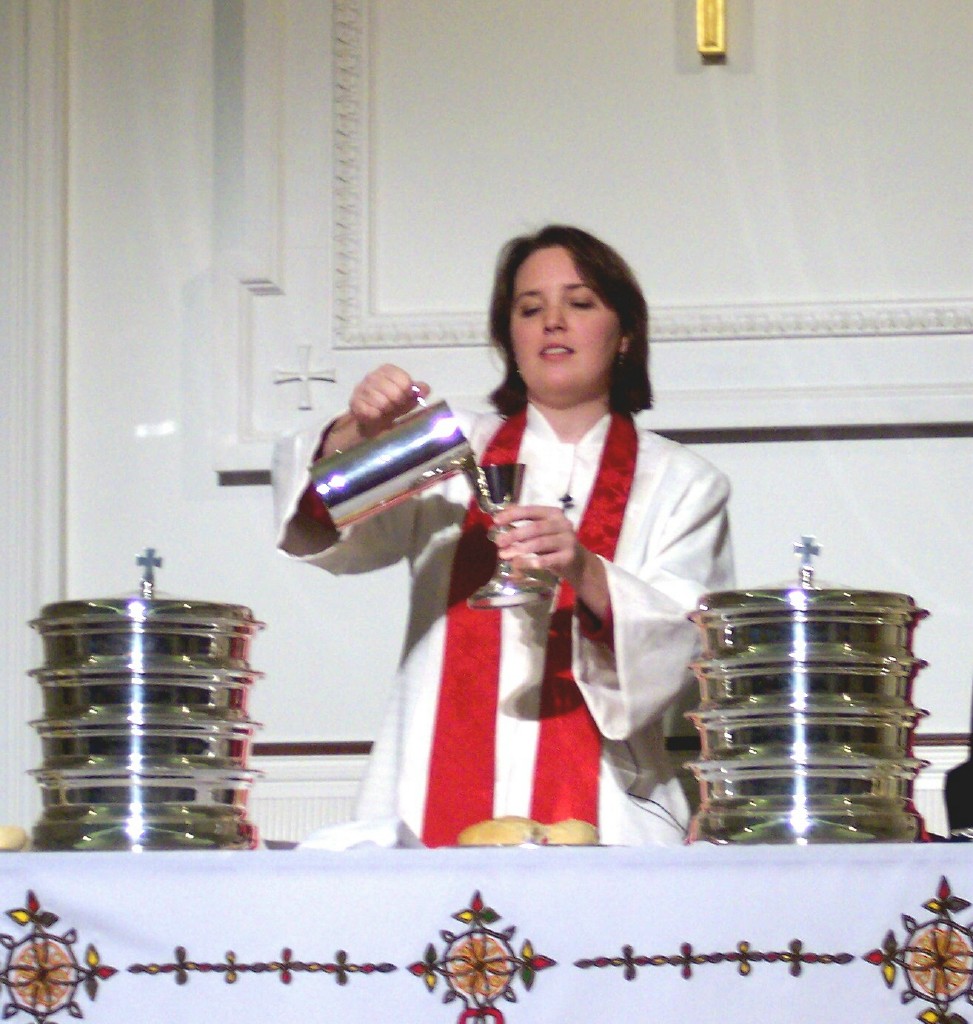
My sister Dawn just sent me the pictures she took of my ordination. I thought I'd post this one - my first time serving communion! I'm not getting a very good pour because I'm left-handed and the pitcher was set at the right hand - I was afraid I'd spill juice everywhere if I went for the big one.
After several months and several times serving communion, it was a pleasant treat to receive a picture of my first time presiding at the Table. I'm no longer anywhere near as nervous and we're working on that left vs right handed pitcher thing!
Tuesday, January 03, 2006
Happy No Longer New Year, Not Quite Epiphany
Has everyone recovered yet? Has anyone recovered yet? I'm still working on getting my legs back under me after the whirlwind that was the season - and my family.
I was a little nervous about this Christmas - it was the first one I was hosting for my family, the first one as an ordained minister. I was nervous that I wouldn't feel the joy and hope and excitement that I usually feel. I was nervous that Christmas would be lost in my long list of things to do.
This season came and went (well, for you sticklers out there, it's still here for a couple more days) and it was different. I was busier than I've ever been around the holiday, I didn't get to sleep in or wake up to look for my stocking (in my family we take the stockings down and 'Santa' fills it up and puts it somewhere around the room) as I was one of those who filled the stockings. And for the first time in I don't know how many years, I didn't eat the traditional Beef Wellington for Christmas dinner (though that's a lot more because of my newish veggie status than my new minister status).
Christmas was different, but it was also wonderful. I loved being among this church family, loved all the well wishes and celebrations shared, loved having my family mix with this family, loved my home being filled with LOUD laughter and so much silliness. I was honored to be able to lead worship on Christmas Eve and Day, blessed with the movement of the Spirit within me, with that warm joy and power it brings. And I was blessed with some familiarity amid all the changes - the candlelight, the boiled custard that always takes me 2 hours to make, the sounds of my sister and mother singing their own descant on Silent Night.
Hope all had a blessed holiday.
I was a little nervous about this Christmas - it was the first one I was hosting for my family, the first one as an ordained minister. I was nervous that I wouldn't feel the joy and hope and excitement that I usually feel. I was nervous that Christmas would be lost in my long list of things to do.
This season came and went (well, for you sticklers out there, it's still here for a couple more days) and it was different. I was busier than I've ever been around the holiday, I didn't get to sleep in or wake up to look for my stocking (in my family we take the stockings down and 'Santa' fills it up and puts it somewhere around the room) as I was one of those who filled the stockings. And for the first time in I don't know how many years, I didn't eat the traditional Beef Wellington for Christmas dinner (though that's a lot more because of my newish veggie status than my new minister status).
Christmas was different, but it was also wonderful. I loved being among this church family, loved all the well wishes and celebrations shared, loved having my family mix with this family, loved my home being filled with LOUD laughter and so much silliness. I was honored to be able to lead worship on Christmas Eve and Day, blessed with the movement of the Spirit within me, with that warm joy and power it brings. And I was blessed with some familiarity amid all the changes - the candlelight, the boiled custard that always takes me 2 hours to make, the sounds of my sister and mother singing their own descant on Silent Night.
Hope all had a blessed holiday.
Tuesday, December 13, 2005
Yes, Virginia
Yesterday I went back to my second office, the Coffee on the Corner, to "finish" working on my homily for Christmas Day. I was wearing my new sweatshirt, the one that reads "Yes, Virginia, they do ordain women." The man behind the counter gave me a thumbs up, very nice, but then he looked confused and said "so does Virginia not ordain women?" For those who don't know, I live in the state of Virginia. This poor lad was so mixed up. I explained to him that it was a take off of the famous letter to the editor reply. He nodded but kept looking confused. I tried to explain quickly that states don't determine who's ordained or not, but still, confusion.
All in a day's work...
All in a day's work...
Monday, December 12, 2005
What Christmas Carol Are You?
I stole this from my friend Teri. Not surprisingly, we're the same carol.

You are 'Hark! The Herald Angels Sing'. You take
Christmas very seriously. For you, it is a
religious festival, celebrating the birth of
the Saviour, and its current secularisation
really irritates you. You enjoy the period of
Advent leading up to Christmas, and attend any
local carol services you can find, as well as
the more contemplative Advent church services
each Sunday. You may be involved in Christmas
food collections or similar charity work. The
midnight service at your church, with candles
and carols, is one you look forward to all
year, and you also look forward to the family
get together on Christmas Day.
What Christmas Carol are you?
brought to you by
You are 'Hark! The Herald Angels Sing'. You take
Christmas very seriously. For you, it is a
religious festival, celebrating the birth of
the Saviour, and its current secularisation
really irritates you. You enjoy the period of
Advent leading up to Christmas, and attend any
local carol services you can find, as well as
the more contemplative Advent church services
each Sunday. You may be involved in Christmas
food collections or similar charity work. The
midnight service at your church, with candles
and carols, is one you look forward to all
year, and you also look forward to the family
get together on Christmas Day.
What Christmas Carol are you?
brought to you by
Thursday, December 08, 2005
i'll be watching you
I'm currently sitting in Coffee on the Corner which happens to be about 1/2 block away from my apartment. I'm supposed to be working on my sermon for Christmas Day (don't worry, I'm doing that too) but I find myself often distracted by the comings and goings outside.
I love sitting here, being part of the community and being reminded of Covenant while I work. A man next to me happened to mention the name of one of Covenant's members in passing to his companion (I wasn't eavesdropping, I promise!). Then I look out the window and who do I see but Marney - doing what I'm not quite sure, but I do know I enjoyed watching her work.
I have a lovely office (such a beautiful color!) but I love working here. The other day (Saturday after Thanksgiving) I saw I don't know how many Covenant members while I worked on my sermon here. Someone next to me asked if this was my second office and I said yes! And what a great office. Cozy with yummy beverages and what's more, the chance to do my work in the midst of those who I am here to serve. There's just something special about that.
I love sitting here, being part of the community and being reminded of Covenant while I work. A man next to me happened to mention the name of one of Covenant's members in passing to his companion (I wasn't eavesdropping, I promise!). Then I look out the window and who do I see but Marney - doing what I'm not quite sure, but I do know I enjoyed watching her work.
I have a lovely office (such a beautiful color!) but I love working here. The other day (Saturday after Thanksgiving) I saw I don't know how many Covenant members while I worked on my sermon here. Someone next to me asked if this was my second office and I said yes! And what a great office. Cozy with yummy beverages and what's more, the chance to do my work in the midst of those who I am here to serve. There's just something special about that.
Tuesday, December 06, 2005
The Antiphons
You really do learn something new every day.
Today I was searching online for something - I don't even remember what now - and I stumbled across a page aboutthe Antiphons. What are the Antiphons? Oh, so glad you asked. They are short prayers basedon various titles used for the Christ that the church started using in the 8th and 9th centuries. From December 17th to 23rd, the church would offer one of the Antiphons as prayer. O Come, O Come, Emmanuel is based on the last Antiphon.
And without further ado, here they are:
December 17
O WISDOM, who came from the mouth of the Most High, reaching from end to end and ordering all things mightily and sweetly: COME, and teach us the way of prudence. Amen.
December 18
O LORD AND RULER of the House of Israel, who appeared to Moses in the flame of the burning bush and gave him the law on Sinai: COME, and redeem us with outstretched arms. Amen.
December 19
O ROOT OF JESSE, that stands for an ensign of the people, before whom the kings keep silence and unto whom the Gentiles shall make supplication: COME, to deliver us, and tarry not. Amen.
December 20
O KEY OF DAVID, and Sceptre of the House of Israel, who opens and no man shuts, who shuts and no man opens: COME, and bring forth the captive from his prison, he who sits in darkness and in the shadow of death. Amen.
December 21
O DAWN OF THE EAST, brightness of light eternal, and Sun of Justice: COME, and enlighten those who sit in darkness and in the shadow of death. Amen.
December 22
O KING OF THE GENTILES and their desired One, the Cornerstone that makes both one: COME, and deliver man, whom you formed out of the dust of the earth. Amen.
December 23
O EMMANUEL, God with us, Our King and Lawgiver, the expected of the nations and their Saviour: COME to save us, O Lord our God. Amen.
Today I was searching online for something - I don't even remember what now - and I stumbled across a page aboutthe Antiphons. What are the Antiphons? Oh, so glad you asked. They are short prayers basedon various titles used for the Christ that the church started using in the 8th and 9th centuries. From December 17th to 23rd, the church would offer one of the Antiphons as prayer. O Come, O Come, Emmanuel is based on the last Antiphon.
And without further ado, here they are:
December 17
O WISDOM, who came from the mouth of the Most High, reaching from end to end and ordering all things mightily and sweetly: COME, and teach us the way of prudence. Amen.
December 18
O LORD AND RULER of the House of Israel, who appeared to Moses in the flame of the burning bush and gave him the law on Sinai: COME, and redeem us with outstretched arms. Amen.
December 19
O ROOT OF JESSE, that stands for an ensign of the people, before whom the kings keep silence and unto whom the Gentiles shall make supplication: COME, to deliver us, and tarry not. Amen.
December 20
O KEY OF DAVID, and Sceptre of the House of Israel, who opens and no man shuts, who shuts and no man opens: COME, and bring forth the captive from his prison, he who sits in darkness and in the shadow of death. Amen.
December 21
O DAWN OF THE EAST, brightness of light eternal, and Sun of Justice: COME, and enlighten those who sit in darkness and in the shadow of death. Amen.
December 22
O KING OF THE GENTILES and their desired One, the Cornerstone that makes both one: COME, and deliver man, whom you formed out of the dust of the earth. Amen.
December 23
O EMMANUEL, God with us, Our King and Lawgiver, the expected of the nations and their Saviour: COME to save us, O Lord our God. Amen.
Monday, November 28, 2005
what lies beneath
I've posted two sermons today - the one I preached Nov 13, the morning of my ordination day, and the one I preached yesterday.
By the way, I don't know if John or I mention this enough - or at all - but the feedback you give us is so helpful and so appreciated. I'm very thankful that I'm in such an intelligent and outspoken congregation!
By the way, I don't know if John or I mention this enough - or at all - but the feedback you give us is so helpful and so appreciated. I'm very thankful that I'm in such an intelligent and outspoken congregation!
Who Needs Sleep?
Text
Isaiah 64:1-9
Mark 13:24-39
Here’s the scene:
Our hero is about to embark on some dangerous – and sneaky – endeavor. Hero may be interrupted by any number of forces – maybe ninjas dressed all in black, or perhaps huge voracious three-headed dogs ala Harry Potter. Hero, not wanting to be interrupted by any of these, appoints a sidekick to stand guard. Along with offering frothy quips, it’s Sidekick’s job to make sure Hero isn’t caught by surprise when on this dangerous endeavor. Hero goes off on the mission and leaves Sidekick behind as a watch guard – with a plan to alert Hero in case any ninjas pass by.
So Sidekick sits, and Sidekick waits… and Sidekick finds himself yawning… And suddenly, Sidekick is awakened by an annoyed Hero. Apparently, Sidekick had fallen asleep and did not keep watch like he was supposed to. And someone snuck by him. Hero managed to escape a tricky situation and is now looking very displeased.
“I’m sorry,” Sidekick whines. “I swear I didn’t see them slip by.”
“Sidekick, sidekick,” Hero mutters while shaking her head.
Hero doesn’t have much sympathy for her sidekick – but I do. Every time I see or read a scene like that, I feel great empathy for the one left behind. The person seems to have a simple job – just keep alert to anyone that might come by – but that job isn’t as simple as it sounds. It’s physically exhausting to stay alert for a long time. The longer you sit there, scanning your surroundings with attentive eyes and ears, the more energy you use, the more tired you become, the easier it’s going to be to be caught sleeping on the job.
And the longer you sit there, waiting in the dark, your mind starting to play tricks on you, the greater the danger that even if you do stay awake, you won’t recognize what you were looking for as it passes right by. The person you’re on lookout for could walk right by, perhaps go as far as to wave “Hi,” and he or she wouldn’t even register on your tired mind.
It’s because of this tired state, one I’ve felt while waiting for professors to call on me for example, that I have such sympathy for sidekicks all over. It is also this tired state that makes me appreciate the challenge that comes in waiting. And it is this tired state that gives me some small, very small, semblance of an understanding of what it might have been like to wait for the Messiah.
A perennially oppressed people, the Israelites waited years, hundreds and hundreds of years, for someone who would rise up and deliver them from their oppression.
The Israelites waited… and they waited… and they waited. And during this time, they spoke boldly and proudly about the power of God. The prophet Isaiah spoke of a God who would “tear open the heavens and come down.” Mountains would quake – quake like a pot of water boiling atop a raging fire. Whole nations would tremble at the sight of this great God coming down from the heavens. God’s coming would be truly awe-inspiring – and definitely noticeable.
A silent night, however holy, would not usher in the coming of God. God would come to deliver the people with huge displays of power that would been seen and heard from the ends of the earth. And whatever Messiah the Lord sent would be come with such an explosive exhibition.
Throughout the Assyrian, Babylonian, Persian, and Roman occupancies, the people of Israel waited for this marvelous power of God, waited for deliverance. Finally, one night, a night marked only by a bright star and a singing telegram for some shepherds in a field, the Messiah came. God came. While Mary may have moaned and wailed as though the heavens were being torn apart, mountains did not quake and all the nations did not immediately tremble. And a people who had waited for so long did not all see the answer to their prayers when it came.
Yes, there were signs like the star and people like Herod and the wise men who recognized a powerful someone had arrived – but these signs were not exactly like what the people were expecting – this Messiah was not exactly like the people were expecting. And so even though Jesus walked among them, performing signs and miracles, many people did not see him. He walked right by, waving “Hi,” without them even noticing. The years of waiting had numbed them, so that though they looked they did not perceive, though they listened they did not understand.
The Israelites are not the only waiting people whose expectations were not met. The earliest followers of Jesus, those who did look and perceive, listen and understand, were waiting too, waiting for Christ to come again. They waited for him to come down in the clouds he had been taken up in. Soon, they believed, would he come. After all, Jesus was recorded as saying that “this generation will not pass until all these things – until the Son of Man comes again and sends out the angels to gather the elect – this generation will not pass until these things have taken place.” And so, the people waited, living in the moment because they believed at any moment, Christ would come again.
Whether or not Jesus was speaking of a generation like we would think of it, the people of Jesus’ generation did expect him to come again before they passed. When he didn’t, the following generations had to deal with that disappointment. Perhaps they began to look more closely at Jesus’ saying that no one – not the angels in heaven nor even the Son – knows when the day and hour will come. Only the Father knows. In the face of this unknown, as each generation passed, the people waited, some with more urgency and alertness than others. They waited… and they waited… and they waited until “they” became “we.”
It’s 2,000 years later and we are still waiting. In this season of Advent, we recognize especially our inheritance of the charge to be alert, to keep awake, to stand guard waiting for the Lord. During these four weeks we prepare ourselves for the coming of Christ. Though we celebrate especially the coming of Christ years ago as a child, this is not the only coming we await, not the only advent we celebrate.
Like our ancestors of faith, we keep alert for the coming of Christ into this world again; we await the time when the sun will be darkened, the moon no longer gives light, the stars fall from the sky, and the Son of Man comes in the clouds with great power and glory.
Like the ancient Israelites and the first followers of Jesus before us, we are now the watch guards, awaiting the arrival of Christ our Master, watch guards who will – of course – recognize the Son of Man as he’s coming in those clouds…
While I think you and I are truly beloved people, graced people made in the image of God, I harbor no illusions about our ability to stay awake. It’s hard work to keep constantly awake, to keep continually alert for the coming of Christ. While the Son of Man may indeed come in the clouds, while the sun indeed darken and the moon no longer shine, we should take to heart the reaction of those who waited for the Messiah before us. We, too, may fall asleep, may find ourselves numbed to the signs, blind and deaf to the heralding of Christ’s coming.
Or perhaps we will be like the others – like the hemorrhaging woman, like the beggars in the street, like the fishermen who answered a call – those who saw Christ and knew, or at the very least had an idea. They may not have been expecting the Messiah to be a poor carpenter, but when he passed by them, when they heard stories about him, they knew there was something about this man, something that called them to faith.
Whether we will be like those who did not understand or be like those who saw in a humble man the Son of God, depends on whether or not we can keep awake, keep alert to the signs. A challenge, to be sure. But one we can, with God’s help, rise up to meet.
Our ability to stay alert for Christ over in this season of Advent, in the months and years beyond this season, may be found within the third kind of advent we celebrate this season. As we celebrate Christ’s coming as a child, Christ’s coming again, we also celebrate the ways in which Christ is manifested here and now. We celebrate the light of Christ in each and everyone of us. And it is this light, this coming of Christ here and now, that will help keep us awake.
If you want to be prepared for the hour and the day when Christ comes again – then look now for Christ around you. In every person you meet, look for the light of Christ. Sometimes seeing Christ will be easy – the kindly matron who serves at the soup kitchen, the sweet man who takes care of all the stray animals that come his way, the adorable child who offers hugs and expressions of love with such abandon. Christ just radiates from people like this.
Seeing Christ in some people is going to be much harder, take much more effort. There is no denying that it is hard to see Christ in people who appear to know only how to hurt, to see the light of God in those who inflict pain as easily as others express love. And yet as all people are made in the image of God, all people have the light of Christ within them. Truly, some people’s lights will be so covered with darkness that you and I may never see it. But that doesn’t mean we do not keep trying, do not keep looking for that light. If we stay alert, we might be surprised with a glimpse of light shining from even the darkest person.
As you prepare for a joy-filled Christmas Day, as you put up the decorations, plan what you’re going to eat at the big feast, get ready for friends and family from far and wide to come home for the holidays, keep awake for the coming of Christ. Keep alert to the presence of Christ among you here and now. For if we keep awake, keep alert, then when the master does finally come home, we will not be caught asleep. Instead, whether in the evening, at midnight, at the cockcrow, at dawn, when Christ arrives we will be prepared, we will rise up and greet him with delight, saying “Hello, dear friend, prince of peace, king of kings, sweet savior – welcome home.” What a joyous day that will be. Amen.
Isaiah 64:1-9
Mark 13:24-39
Here’s the scene:
Our hero is about to embark on some dangerous – and sneaky – endeavor. Hero may be interrupted by any number of forces – maybe ninjas dressed all in black, or perhaps huge voracious three-headed dogs ala Harry Potter. Hero, not wanting to be interrupted by any of these, appoints a sidekick to stand guard. Along with offering frothy quips, it’s Sidekick’s job to make sure Hero isn’t caught by surprise when on this dangerous endeavor. Hero goes off on the mission and leaves Sidekick behind as a watch guard – with a plan to alert Hero in case any ninjas pass by.
So Sidekick sits, and Sidekick waits… and Sidekick finds himself yawning… And suddenly, Sidekick is awakened by an annoyed Hero. Apparently, Sidekick had fallen asleep and did not keep watch like he was supposed to. And someone snuck by him. Hero managed to escape a tricky situation and is now looking very displeased.
“I’m sorry,” Sidekick whines. “I swear I didn’t see them slip by.”
“Sidekick, sidekick,” Hero mutters while shaking her head.
Hero doesn’t have much sympathy for her sidekick – but I do. Every time I see or read a scene like that, I feel great empathy for the one left behind. The person seems to have a simple job – just keep alert to anyone that might come by – but that job isn’t as simple as it sounds. It’s physically exhausting to stay alert for a long time. The longer you sit there, scanning your surroundings with attentive eyes and ears, the more energy you use, the more tired you become, the easier it’s going to be to be caught sleeping on the job.
And the longer you sit there, waiting in the dark, your mind starting to play tricks on you, the greater the danger that even if you do stay awake, you won’t recognize what you were looking for as it passes right by. The person you’re on lookout for could walk right by, perhaps go as far as to wave “Hi,” and he or she wouldn’t even register on your tired mind.
It’s because of this tired state, one I’ve felt while waiting for professors to call on me for example, that I have such sympathy for sidekicks all over. It is also this tired state that makes me appreciate the challenge that comes in waiting. And it is this tired state that gives me some small, very small, semblance of an understanding of what it might have been like to wait for the Messiah.
A perennially oppressed people, the Israelites waited years, hundreds and hundreds of years, for someone who would rise up and deliver them from their oppression.
The Israelites waited… and they waited… and they waited. And during this time, they spoke boldly and proudly about the power of God. The prophet Isaiah spoke of a God who would “tear open the heavens and come down.” Mountains would quake – quake like a pot of water boiling atop a raging fire. Whole nations would tremble at the sight of this great God coming down from the heavens. God’s coming would be truly awe-inspiring – and definitely noticeable.
A silent night, however holy, would not usher in the coming of God. God would come to deliver the people with huge displays of power that would been seen and heard from the ends of the earth. And whatever Messiah the Lord sent would be come with such an explosive exhibition.
Throughout the Assyrian, Babylonian, Persian, and Roman occupancies, the people of Israel waited for this marvelous power of God, waited for deliverance. Finally, one night, a night marked only by a bright star and a singing telegram for some shepherds in a field, the Messiah came. God came. While Mary may have moaned and wailed as though the heavens were being torn apart, mountains did not quake and all the nations did not immediately tremble. And a people who had waited for so long did not all see the answer to their prayers when it came.
Yes, there were signs like the star and people like Herod and the wise men who recognized a powerful someone had arrived – but these signs were not exactly like what the people were expecting – this Messiah was not exactly like the people were expecting. And so even though Jesus walked among them, performing signs and miracles, many people did not see him. He walked right by, waving “Hi,” without them even noticing. The years of waiting had numbed them, so that though they looked they did not perceive, though they listened they did not understand.
The Israelites are not the only waiting people whose expectations were not met. The earliest followers of Jesus, those who did look and perceive, listen and understand, were waiting too, waiting for Christ to come again. They waited for him to come down in the clouds he had been taken up in. Soon, they believed, would he come. After all, Jesus was recorded as saying that “this generation will not pass until all these things – until the Son of Man comes again and sends out the angels to gather the elect – this generation will not pass until these things have taken place.” And so, the people waited, living in the moment because they believed at any moment, Christ would come again.
Whether or not Jesus was speaking of a generation like we would think of it, the people of Jesus’ generation did expect him to come again before they passed. When he didn’t, the following generations had to deal with that disappointment. Perhaps they began to look more closely at Jesus’ saying that no one – not the angels in heaven nor even the Son – knows when the day and hour will come. Only the Father knows. In the face of this unknown, as each generation passed, the people waited, some with more urgency and alertness than others. They waited… and they waited… and they waited until “they” became “we.”
It’s 2,000 years later and we are still waiting. In this season of Advent, we recognize especially our inheritance of the charge to be alert, to keep awake, to stand guard waiting for the Lord. During these four weeks we prepare ourselves for the coming of Christ. Though we celebrate especially the coming of Christ years ago as a child, this is not the only coming we await, not the only advent we celebrate.
Like our ancestors of faith, we keep alert for the coming of Christ into this world again; we await the time when the sun will be darkened, the moon no longer gives light, the stars fall from the sky, and the Son of Man comes in the clouds with great power and glory.
Like the ancient Israelites and the first followers of Jesus before us, we are now the watch guards, awaiting the arrival of Christ our Master, watch guards who will – of course – recognize the Son of Man as he’s coming in those clouds…
While I think you and I are truly beloved people, graced people made in the image of God, I harbor no illusions about our ability to stay awake. It’s hard work to keep constantly awake, to keep continually alert for the coming of Christ. While the Son of Man may indeed come in the clouds, while the sun indeed darken and the moon no longer shine, we should take to heart the reaction of those who waited for the Messiah before us. We, too, may fall asleep, may find ourselves numbed to the signs, blind and deaf to the heralding of Christ’s coming.
Or perhaps we will be like the others – like the hemorrhaging woman, like the beggars in the street, like the fishermen who answered a call – those who saw Christ and knew, or at the very least had an idea. They may not have been expecting the Messiah to be a poor carpenter, but when he passed by them, when they heard stories about him, they knew there was something about this man, something that called them to faith.
Whether we will be like those who did not understand or be like those who saw in a humble man the Son of God, depends on whether or not we can keep awake, keep alert to the signs. A challenge, to be sure. But one we can, with God’s help, rise up to meet.
Our ability to stay alert for Christ over in this season of Advent, in the months and years beyond this season, may be found within the third kind of advent we celebrate this season. As we celebrate Christ’s coming as a child, Christ’s coming again, we also celebrate the ways in which Christ is manifested here and now. We celebrate the light of Christ in each and everyone of us. And it is this light, this coming of Christ here and now, that will help keep us awake.
If you want to be prepared for the hour and the day when Christ comes again – then look now for Christ around you. In every person you meet, look for the light of Christ. Sometimes seeing Christ will be easy – the kindly matron who serves at the soup kitchen, the sweet man who takes care of all the stray animals that come his way, the adorable child who offers hugs and expressions of love with such abandon. Christ just radiates from people like this.
Seeing Christ in some people is going to be much harder, take much more effort. There is no denying that it is hard to see Christ in people who appear to know only how to hurt, to see the light of God in those who inflict pain as easily as others express love. And yet as all people are made in the image of God, all people have the light of Christ within them. Truly, some people’s lights will be so covered with darkness that you and I may never see it. But that doesn’t mean we do not keep trying, do not keep looking for that light. If we stay alert, we might be surprised with a glimpse of light shining from even the darkest person.
As you prepare for a joy-filled Christmas Day, as you put up the decorations, plan what you’re going to eat at the big feast, get ready for friends and family from far and wide to come home for the holidays, keep awake for the coming of Christ. Keep alert to the presence of Christ among you here and now. For if we keep awake, keep alert, then when the master does finally come home, we will not be caught asleep. Instead, whether in the evening, at midnight, at the cockcrow, at dawn, when Christ arrives we will be prepared, we will rise up and greet him with delight, saying “Hello, dear friend, prince of peace, king of kings, sweet savior – welcome home.” What a joyous day that will be. Amen.
Oh, Inverted World
Text
Judges 4
When I was a kid I loved reading the Bible. I’d start at Genesis and read all the way through. Okay, that’s not quite true. I’d start at Genesis with the intent of reading all the way through, but I always seemed to get stuck at about the same part – the middle of Exodus. Once that book turned from an exciting story of daring escape, of plagues and miracles, to talk about laws and the very detailed ways to worship God, I stopped reading. I suppose I have enough OCD tendencies that skipping ahead just wasn’t an option. So when I picked up the Bible again, I’d start at Genesis. Once, I got through the whole of Exodus but I didn’t make it much further. If I thought the second half of Exodus was as boring as it could get, Leviticus proved me wrong. Needless to say, in these childhood marathon readings of the Bible, I got to know Genesis and Moses real well and that was about it.
Had I known that just past Leviticus, Deuteronomy, and Joshua, there would be a book like Judges waiting for me, I might have kept on reading just to get to the good part. Judges is a fascinating book about the twelve people who were designated as judges, rulers over and saviors of Israel – and this history of Israel’s pre-monarchial society is quite a juicy read.
While there are a few judges whose brief entries read like the cliffs notes to the cliffs notes version of their lives, other judges’ stories are told with such passion and engagement that I don’t need to be a kid with a wild imagination and a yearning for adventure to appreciate them. The history of Israel’s early period is filled with fascinating people who perform feats that seem impossible for mere mortals, people who defend their nation against indescribable odds.
You could say these stories are the big action summer blockbusters of their time. Instead of seeing Spiderman swinging from skyscraper to skyscraper, we have Samson tearing down buildings with his God-given brute strength. Rather than Will Smith saving the world from yet another alien invasion with yet another unrealistic save-the-day solution, there’s Gideon sending the enemy into panic and subsequently defeating them by surrounding them at night with his mere 300 men and creating such a cacophony of blowing trumpets, breaking jars, shouting war cries.
Unfortunately not unlike your stereotypical action movie, the book of Judges has some troubling roles for women. We, of course, have Delilah, who seduces Samson and cuts off the source of his power, literally. Delilah may come only second to Jezebel in giving women a bad rap. Along with Delilah, there are several women in Judges who give more serious concern to readers. The stories of Jepthath’s daughter and the Levite’s concubine are some of the most disturbing narratives in the entire Bible. Stories about the violent fates of women at the hands of men who were supposed to protect them. Stories that make it a true and honest challenge to see within them a just and loving God.
Though Judges bears these two disturbing stories, it also contains two of the most powerful women in the whole of our sacred texts. Perhaps it wouldn’t surprise most of you to know that I come from a large family full of strong women – many of whom are here this morning. I have a great appreciation for powerful females. In our text, we meet two of my favorite strong femmes, Deborah and Jael.
Our story begins by setting the stage for Deborah’s introduction. Israel does evil in the sight of the Lord, something it seems to do rather frequently in this particular book, and finds itself being oppressed by King Jabin and his military commander Sisera for 20 years. Israel cries out to God for relief – enter Deborah. Deborah is a prophetess and has become a judge over Israel. After all this campaigning we’ve seen for the governor’s race among others, I find Deborah’s claim to leadership rather refreshing. She didn’t seek anybody out, pass out bumper stickers or flyers, spend millions on negative ads or political advisors. Her wisdom and charisma, her fiery nature, were more than enough to draw people to her. She just sat under a tree and let the people come.
As this wise leader, she preaches God’s prophetic word to the people, here in particular Barak. And Deborah isn’t just a guru who stays under the relative calm of her tree’s shade, passing out proclamations. She accompanies the military commander Barak on his mission and inspires the charge for battle. For a woman of unassuming origins, sitting under that adeptly named tree, she proves a captivating character.
Our other fascinating female at first seems rather unassuming as well. Jael enters the scene innocently enough, coming out to meet Sisera, the man whose leader was her husband’s friend, offering him assurances and the comfort of her tent. I’ve lived most of my life in the South, a place – as I’m sure many of you know – that prides itself on hospitality. Now at first it seems Jael would fit right in, be a perfect example of our Southern hospitality. She gives this man on the run who has just seen his entire army destroyed (well, had he stayed for the battle would have just seen his entire army destroyed) a place of refuge. She covers him with a rug and gives him milk when he just asked for water.
Of course, what Jael does next, you know driving a tent peg into Sisera’s temple until it reaches the ground, might disqualify her from winning any Sweet Southern Miss contest. Though she starts out so seemingly sweet, she, uh, hammers home just how fierce she can be. It is Jael the homemaker, not Barak the military commander, who ends up wining the day and the glory; though Barak defeats Sisera’s army, Jael defeats Sisera himself.
These women are strong and brave, so brave in fact that they have been at the center of some heated discussions. Women need to be sheltered, you say? How could women be considered in need of shelter and protection when you have the example of Jael, a resourceful woman who took instruments she would have on hand, and simply and apparently calmly takes on a man who until a few hours before had been commander of 900 iron chariots? It’s hard to see women as weak and helpless with Jael around.
And in conversations over the centuries, people have turned to Deborah as an example of why women can and should be leaders in the church – a woman once was a leader of the whole people Israel after all. On the other side of that debate, people such as our own favorite theologian John Calvin have said that Deborah was a special case, that not all women should be regarded on her level and she was just unusually gifted.
Some have gone further than limiting the potential found in Deborah’s amazing story, by trying to discredit either Deborah or Jael’s achievements. More than one commentator, classic and contemporary, has suggested that though Deborah was a prophetess and offering wisdom and governance to Israel, she wasn’t a complete judge because she needed Barak for the all important military prowess. Now, true, the other judges in this book were men who fought battles, and so Deborah doesn’t quite fit the mold. But if we remember the story, then we know that Barak refused to go into battle without Deborah, and that it was she who commanded the day of attack and even gave the big rally the troops speech.
As for Jael, well some have been quick to point out that she broke rules of hospitality. In the ancient world, hospitality was not just about offering someone a nice meal or a place to crash – it was about survival. With no motels or rest stops along well-paved highways, the people of the Middle East had to rely on the kindness of strangers when they were crossing long distances or fleeing from an enemy. When you invited someone into your home, you were promising them protection against harm by nature or by humans. Jael, well, she doesn’t let either nature or Sisera’s persecutors get him, but he certainly doesn’t stay safe in her care.
However, I would think that one cannot really accuse Jael of breaking the rules of hospitality if one considers Sisera’s own acts. You wanna talk breaking the rules – how about a commander abandoning his troops when things get a little hairy. And while Jael offered it, given the rules of their time, Sisera should never have accepted her hospitality – only the hospitality of her husband. By accepting her offer to hide him, Sisera proved himself a doubly unworthy man and perhaps even left Jael to suspect he might want more from her than shelter and a drink of water.
Lest we think it’s just a gender thing, I really should point out that while there are those who would lessen Deborah and Jael’s contributions, there are also those who would diminish Barak’s role. Poor Barak, sandwiched between these two unique women, he tends to get lost in their glory. Deborah is the brains and Jael the brawn and Barak, he’s the filler. He’s what gets us from Deborah’s wise leadership to the grand and gory finale; a plot device, really, and nothing more meaningful or important.
Except that’s not it either. Amid all the commentaries I’ve read and in conversations I’ve had recent and past, most people don’t know how to handle this trio of actors. And I don’t blame them. The world of judges is inverted in this story. The pattern of every other judge isn’t followed here. Instead of one strong man freeing Israel from oppression, we have several strong people, including two women. So folk keep trying to play around with the story, to find a way to make one of these people more important than the other. You would think we Christians would find it a little easier to understand and accept that through three persons Israel was delivered. Instead, many of us keep trying to force one or another into the role of true hero.
But that’s not going to work. Think square peg, a square tent peg if you like, in a round hole. Without Barak, Deborah wouldn’t have had any army to charge; without Barak, Jael wouldn’t have had any one to chase Sisera off in her direction. Without Deborah, Barak wouldn’t have heard the command of God to start the whole thing off and without Jael, Deborah and Barak wouldn’t have seen an end to Sisera’s tyranny. Each needs the other and each is important to the others.
When we try and force one or another of these characters into being the star of the story, we miss out on the beauty of this collaborative effort. We miss out on interplay of each person’s different gifts as they weave together to create this story of freedom.
And what’s more, by trying to show one of this human characters as the true actor of salvation, we forget the source of that salvation. We forget that though Deborah was a wise leader, Barak a good military commander, Jael a brave, resourceful woman, God is the one who spoke first to Deborah, God is the one who sent Sisera’s army into a panic that caused him to flee. God is the source of all their gifts and their call to action. God is at work in these people’s actions and it is God who is savior, who is the true judge, true leader of the people. God is, or at least should be, the focus of our attention just as God is the focus of this narrative.
The story does not end with a summation of Deborah’s works or Jael’s bravery, or a list of Barak’s military conquests. It ends with: And so on that day God subdued King Jabin of Canaan before the Israelite. It ends with a statement ascribing to God the glory for what came to pass. And following the narrative is a beautiful song that beings and ends the retelling of this story with ultimate praise to God.
God’s part in this story as with our own story, is as source of the gifts which bring about good things, as inspiration to seek out freedom from our oppression. And just like our forbearers of faith, our part is to be inspired by God and to seek out what God would have for us, whether we be Deborahs, Baraks, or Jaels.
So glory be to the God who works within us all, who weaves our gifts together, and moves us toward freedom from all that binds us.
Judges 4
When I was a kid I loved reading the Bible. I’d start at Genesis and read all the way through. Okay, that’s not quite true. I’d start at Genesis with the intent of reading all the way through, but I always seemed to get stuck at about the same part – the middle of Exodus. Once that book turned from an exciting story of daring escape, of plagues and miracles, to talk about laws and the very detailed ways to worship God, I stopped reading. I suppose I have enough OCD tendencies that skipping ahead just wasn’t an option. So when I picked up the Bible again, I’d start at Genesis. Once, I got through the whole of Exodus but I didn’t make it much further. If I thought the second half of Exodus was as boring as it could get, Leviticus proved me wrong. Needless to say, in these childhood marathon readings of the Bible, I got to know Genesis and Moses real well and that was about it.
Had I known that just past Leviticus, Deuteronomy, and Joshua, there would be a book like Judges waiting for me, I might have kept on reading just to get to the good part. Judges is a fascinating book about the twelve people who were designated as judges, rulers over and saviors of Israel – and this history of Israel’s pre-monarchial society is quite a juicy read.
While there are a few judges whose brief entries read like the cliffs notes to the cliffs notes version of their lives, other judges’ stories are told with such passion and engagement that I don’t need to be a kid with a wild imagination and a yearning for adventure to appreciate them. The history of Israel’s early period is filled with fascinating people who perform feats that seem impossible for mere mortals, people who defend their nation against indescribable odds.
You could say these stories are the big action summer blockbusters of their time. Instead of seeing Spiderman swinging from skyscraper to skyscraper, we have Samson tearing down buildings with his God-given brute strength. Rather than Will Smith saving the world from yet another alien invasion with yet another unrealistic save-the-day solution, there’s Gideon sending the enemy into panic and subsequently defeating them by surrounding them at night with his mere 300 men and creating such a cacophony of blowing trumpets, breaking jars, shouting war cries.
Unfortunately not unlike your stereotypical action movie, the book of Judges has some troubling roles for women. We, of course, have Delilah, who seduces Samson and cuts off the source of his power, literally. Delilah may come only second to Jezebel in giving women a bad rap. Along with Delilah, there are several women in Judges who give more serious concern to readers. The stories of Jepthath’s daughter and the Levite’s concubine are some of the most disturbing narratives in the entire Bible. Stories about the violent fates of women at the hands of men who were supposed to protect them. Stories that make it a true and honest challenge to see within them a just and loving God.
Though Judges bears these two disturbing stories, it also contains two of the most powerful women in the whole of our sacred texts. Perhaps it wouldn’t surprise most of you to know that I come from a large family full of strong women – many of whom are here this morning. I have a great appreciation for powerful females. In our text, we meet two of my favorite strong femmes, Deborah and Jael.
Our story begins by setting the stage for Deborah’s introduction. Israel does evil in the sight of the Lord, something it seems to do rather frequently in this particular book, and finds itself being oppressed by King Jabin and his military commander Sisera for 20 years. Israel cries out to God for relief – enter Deborah. Deborah is a prophetess and has become a judge over Israel. After all this campaigning we’ve seen for the governor’s race among others, I find Deborah’s claim to leadership rather refreshing. She didn’t seek anybody out, pass out bumper stickers or flyers, spend millions on negative ads or political advisors. Her wisdom and charisma, her fiery nature, were more than enough to draw people to her. She just sat under a tree and let the people come.
As this wise leader, she preaches God’s prophetic word to the people, here in particular Barak. And Deborah isn’t just a guru who stays under the relative calm of her tree’s shade, passing out proclamations. She accompanies the military commander Barak on his mission and inspires the charge for battle. For a woman of unassuming origins, sitting under that adeptly named tree, she proves a captivating character.
Our other fascinating female at first seems rather unassuming as well. Jael enters the scene innocently enough, coming out to meet Sisera, the man whose leader was her husband’s friend, offering him assurances and the comfort of her tent. I’ve lived most of my life in the South, a place – as I’m sure many of you know – that prides itself on hospitality. Now at first it seems Jael would fit right in, be a perfect example of our Southern hospitality. She gives this man on the run who has just seen his entire army destroyed (well, had he stayed for the battle would have just seen his entire army destroyed) a place of refuge. She covers him with a rug and gives him milk when he just asked for water.
Of course, what Jael does next, you know driving a tent peg into Sisera’s temple until it reaches the ground, might disqualify her from winning any Sweet Southern Miss contest. Though she starts out so seemingly sweet, she, uh, hammers home just how fierce she can be. It is Jael the homemaker, not Barak the military commander, who ends up wining the day and the glory; though Barak defeats Sisera’s army, Jael defeats Sisera himself.
These women are strong and brave, so brave in fact that they have been at the center of some heated discussions. Women need to be sheltered, you say? How could women be considered in need of shelter and protection when you have the example of Jael, a resourceful woman who took instruments she would have on hand, and simply and apparently calmly takes on a man who until a few hours before had been commander of 900 iron chariots? It’s hard to see women as weak and helpless with Jael around.
And in conversations over the centuries, people have turned to Deborah as an example of why women can and should be leaders in the church – a woman once was a leader of the whole people Israel after all. On the other side of that debate, people such as our own favorite theologian John Calvin have said that Deborah was a special case, that not all women should be regarded on her level and she was just unusually gifted.
Some have gone further than limiting the potential found in Deborah’s amazing story, by trying to discredit either Deborah or Jael’s achievements. More than one commentator, classic and contemporary, has suggested that though Deborah was a prophetess and offering wisdom and governance to Israel, she wasn’t a complete judge because she needed Barak for the all important military prowess. Now, true, the other judges in this book were men who fought battles, and so Deborah doesn’t quite fit the mold. But if we remember the story, then we know that Barak refused to go into battle without Deborah, and that it was she who commanded the day of attack and even gave the big rally the troops speech.
As for Jael, well some have been quick to point out that she broke rules of hospitality. In the ancient world, hospitality was not just about offering someone a nice meal or a place to crash – it was about survival. With no motels or rest stops along well-paved highways, the people of the Middle East had to rely on the kindness of strangers when they were crossing long distances or fleeing from an enemy. When you invited someone into your home, you were promising them protection against harm by nature or by humans. Jael, well, she doesn’t let either nature or Sisera’s persecutors get him, but he certainly doesn’t stay safe in her care.
However, I would think that one cannot really accuse Jael of breaking the rules of hospitality if one considers Sisera’s own acts. You wanna talk breaking the rules – how about a commander abandoning his troops when things get a little hairy. And while Jael offered it, given the rules of their time, Sisera should never have accepted her hospitality – only the hospitality of her husband. By accepting her offer to hide him, Sisera proved himself a doubly unworthy man and perhaps even left Jael to suspect he might want more from her than shelter and a drink of water.
Lest we think it’s just a gender thing, I really should point out that while there are those who would lessen Deborah and Jael’s contributions, there are also those who would diminish Barak’s role. Poor Barak, sandwiched between these two unique women, he tends to get lost in their glory. Deborah is the brains and Jael the brawn and Barak, he’s the filler. He’s what gets us from Deborah’s wise leadership to the grand and gory finale; a plot device, really, and nothing more meaningful or important.
Except that’s not it either. Amid all the commentaries I’ve read and in conversations I’ve had recent and past, most people don’t know how to handle this trio of actors. And I don’t blame them. The world of judges is inverted in this story. The pattern of every other judge isn’t followed here. Instead of one strong man freeing Israel from oppression, we have several strong people, including two women. So folk keep trying to play around with the story, to find a way to make one of these people more important than the other. You would think we Christians would find it a little easier to understand and accept that through three persons Israel was delivered. Instead, many of us keep trying to force one or another into the role of true hero.
But that’s not going to work. Think square peg, a square tent peg if you like, in a round hole. Without Barak, Deborah wouldn’t have had any army to charge; without Barak, Jael wouldn’t have had any one to chase Sisera off in her direction. Without Deborah, Barak wouldn’t have heard the command of God to start the whole thing off and without Jael, Deborah and Barak wouldn’t have seen an end to Sisera’s tyranny. Each needs the other and each is important to the others.
When we try and force one or another of these characters into being the star of the story, we miss out on the beauty of this collaborative effort. We miss out on interplay of each person’s different gifts as they weave together to create this story of freedom.
And what’s more, by trying to show one of this human characters as the true actor of salvation, we forget the source of that salvation. We forget that though Deborah was a wise leader, Barak a good military commander, Jael a brave, resourceful woman, God is the one who spoke first to Deborah, God is the one who sent Sisera’s army into a panic that caused him to flee. God is the source of all their gifts and their call to action. God is at work in these people’s actions and it is God who is savior, who is the true judge, true leader of the people. God is, or at least should be, the focus of our attention just as God is the focus of this narrative.
The story does not end with a summation of Deborah’s works or Jael’s bravery, or a list of Barak’s military conquests. It ends with: And so on that day God subdued King Jabin of Canaan before the Israelite. It ends with a statement ascribing to God the glory for what came to pass. And following the narrative is a beautiful song that beings and ends the retelling of this story with ultimate praise to God.
God’s part in this story as with our own story, is as source of the gifts which bring about good things, as inspiration to seek out freedom from our oppression. And just like our forbearers of faith, our part is to be inspired by God and to seek out what God would have for us, whether we be Deborahs, Baraks, or Jaels.
So glory be to the God who works within us all, who weaves our gifts together, and moves us toward freedom from all that binds us.
Subscribe to:
Posts (Atom)